
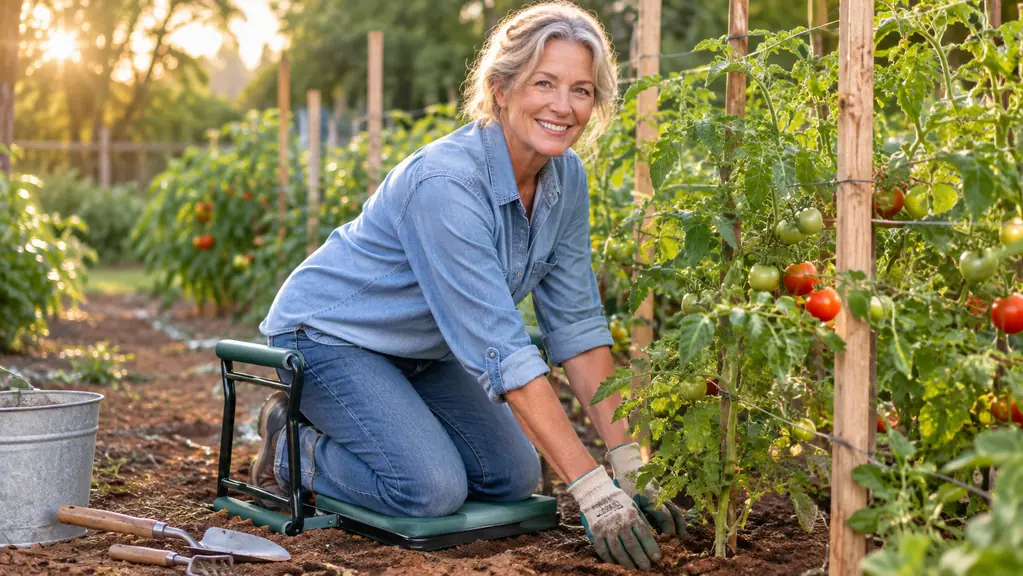
I bought the TomCare garden kneeler and seat in March of 2025, three weeks before I put a single tomato plant in the ground, because I had finally gotten tired of the way I was getting up off the dirt. For six years before that I used a thin foam pad I bought at the hardware store. The pad did the one job it was built for and then left me to handle the rest. Kneeling down was fine. Standing back up was a negotiation with my right knee, my lower back, and whatever fence post happened to be within reach.
The TomCare is the first of five things I bought for this garden in 2025, and it is the one I would replace first if it walked out of the shed tonight. Not because it is clever. Because it handles the half of the job the foam pad never touched, which is the getting back up. I have used it through two full seasons now, spring of 2025 and spring of 2026, in a 20 by 12 foot in-ground plot in red Piedmont clay. Roy does not garden. Doreen two doors down waters with a soaker hose and has never asked to borrow it. This is what a year and a half of honest use looks like.
The Quick Verdict
It solved the part of gardening that actually hurt, which was getting up off the ground. Two seasons in, the steel frame is as tight as it was on day one and the foam pad is dirty. That trade suits me fine.
Amazon Check Today's Price →The 19.1 Inch Seat Is Why I Stopped Dreading the Second Half of the Row
It folds flat, it weighs 7.6 pounds, and it comes out of the box in one piece. That is the whole pitch, and for a sore pair of knees it is enough.
Amazon Check Today's Price on Amazon →How I've Used It
It arrived in March of 2025 and it came out of the box in one piece. No assembly, no bag of bolts, no hunting for the screwdriver I keep in the kitchen drawer. I unfolded it on the concrete patio, sat down on it to see whether it would hold me, and carried it out to the plot. That first weekend I used it to set out the first of the Better Boy transplants, and my knees were sore before I ever got down there.
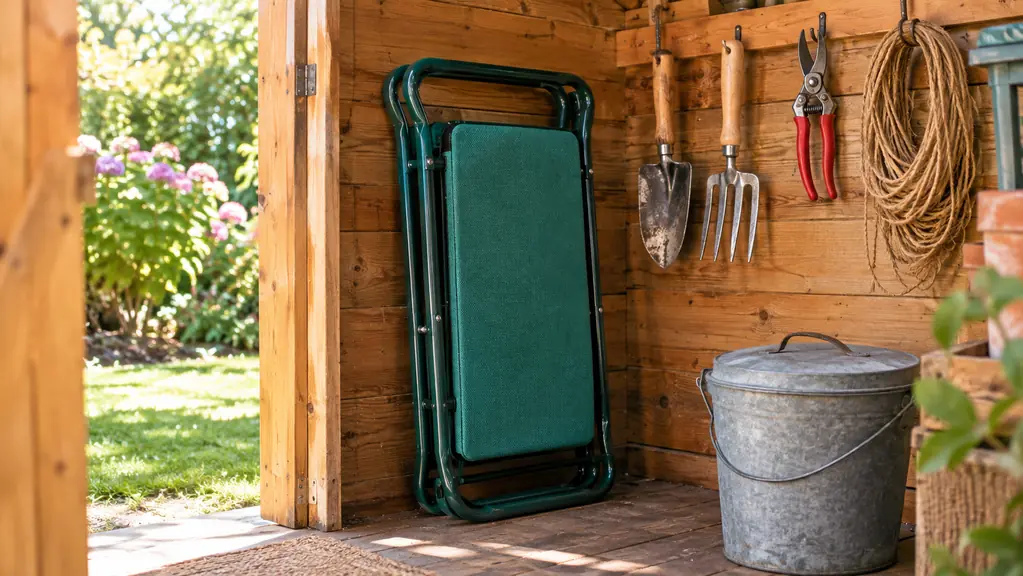
Between uses it lives folded in the shed by the back fence, leaning against the wall beside the peg rack. Folded flat it takes up about as much room as a folded lawn chair and less than the wheelbarrow. At 7.6 pounds I carry it out with one hand and a bucket of transplants in the other. I have never had to make two trips on account of it.
The routine is the same every time. In the in-ground plot I set it down with the pad facing up and kneel on it to set transplants, thin the peppers, and pull the weeds that come up between the rows. When I am picking the low bush beans or reaching under the squash leaves, I flip it over and sit on the seat instead. The frame gives me something to push against when I am ready to stand. Two seasons in and I have not found a fourth use for it, because there is not one.
One thing I did not expect: the plot is uneven, and the sled shaped legs sit on it better than the old pad ever did. The pad used to slide a few inches every time I shifted my weight. The feet on the frame hold where I put them, so I set it down once and it stays where I left it for the whole session.
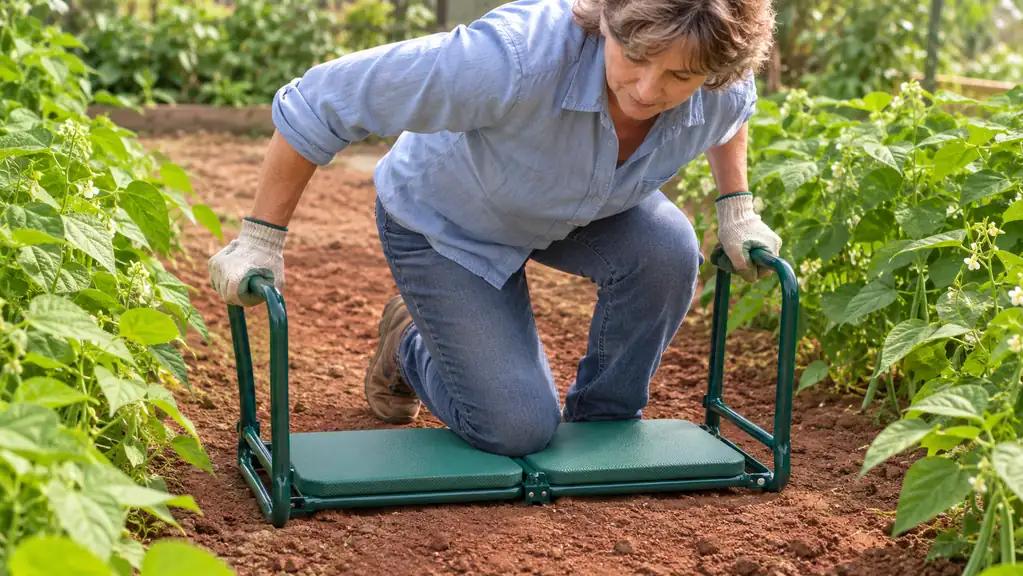
The Flip Is the Whole Point
Every kneeler I looked at before this one was a pad. Some were thicker, some had a strap, and none of them changed the fact that sooner or later you have to get vertical again. The TomCare gives you a rail to push on. I kneel with the pad up, and when I am done I put both hands on the frame and push back and up. My knees still complain. They complain a good deal less when I am not also using a fence post as a crutch.
The seat side matters more than I expected it to. Seat height is 19.1 inches and the seat is 21.85 inches wide, so it is a bench and not a perch. I sit on it to pick the low bush beans and to get under the squash leaves without kneeling in the mud. Standing up from 19 inches is a different activity than getting up off the ground, and by the end of a Saturday my lower back can tell the difference.
The kneeling pad is 11.12 inches wide, which is wider than the foam pad I used for years, and it is EVA foam. It does not take on water the way my old pad did. After a July rain I can set it down in wet clay, kneel on it, and get up with dry knees, which sounds like a small thing until you have spent a morning in wet jeans. The wider pad also means my knees are not hanging off the edges the way they did on the thin one.
The flip takes one hand and about a second. Pad up to kneel, over onto the seat to pick. In the middle of a row I probably flip it four or five times in an afternoon, and it has never pinched a finger or caught on itself. That sounds like nothing. It is the reason I actually use it instead of leaving it in the shed and grumbling.
What Two Seasons Did to the Frame and the Pad
The frame is steel and it has not moved. I am not a small woman and I do not sit down gently, and after two seasons of folding and unfolding it still squares up when it opens. The non-slip feet have held on wet patio concrete, on dry clay, and on the loose mulch at the edge of the plot. I have never had it slide out from under me while I was pushing up off it, which was the one thing I was worried about.
The folding joint is the part that gets the most wear and it has stayed tight. No wobble, no rattle, nothing that makes me think about a rivet letting go. I fold it, carry it out, fold it, carry it back, probably three or four times a week from April through October. It has not gotten looser in any way I can feel.
Every November I fold it, wipe it down, and stand it in the corner of the shed. Every April I pull it back out and it opens the same as it did the year before. That is not a dramatic thing to report, and I have decided that is the point. The last thing I want from a piece of garden equipment is drama.
The one complaint I have is the pad. EVA foam holds up, but it takes on dirt and scuffs and it does not come clean. Mine is a good deal darker than it was in March of 2025 and it has a mark on one corner from where I set it down on a brick. I have wiped it and I have hosed it and it is what it is. If a spotless kneeler matters to you, that is the thing to know going in.
The Two Pouches, and What Actually Lives in Them
There are two tool pouches on the frame. Mine hold a roll of twine and a handful of plant labels, and that is all they hold. They are handy for exactly that, because I got tired of setting the twine down in the dirt and then hunting for it. Clay dust has worked its way into the seams over two seasons and I have not bothered to wash them out.
The Nisaku hori hori does not live in the pouch. It rides on my belt in the sheath while I am working and it hangs on the shed peg rack the rest of the time, and that is where it belongs. A trowel loose in a pouch while you drag the frame around is a good way to lose a trowel. The pouches are for twine and labels, and for those they are the right size.
Where It Fits in the Rest of the Garden Kit
There are four other things I bought for this garden in 2025 and none of them overlaps with the kneeler. The MIXC drip kit waters both the plot and the raised bed, so I am not dragging a hose around every evening. The Espoma Tomato-tone feeds the tomatoes and peppers in the plot. The Nisaku digs, weeds, and opens bags. The Best Choice raised bed sits on the patio and gets worked standing up.
The kneeler only overlaps with the raised bed, and there it loses. Anything that happens at waist height is a standing job and the TomCare has no part in it. Where it earns its keep is the in-ground plot, which is where the tomatoes, peppers, squash and pole beans live, and where all my low work in the clay happens.
So it is not the tool I reach for most. That would be the drip kit in July and the hori hori in June. It is the tool that decides whether I go out at all on a Saturday morning in May when my knees are already stiff from the week. That is a harder thing to put a number on, and I have stopped trying to.
What It Does Not Do
It does nothing for the raised bed. Standing at the Best Choice bed on the patio, the soil is at hip height and there is no reason to kneel or sit at all. The TomCare stays in the shed when I am working the raised bed, which is most of the lettuce and radish work. Two seasons in and I have never once wished I had carried it over to the patio.
It also does not loosen clay. The hard digging in this plot is still the hori hori's job and there is no getting around it. And it did not retire my old foam pad, which is still in the shed and still gets used, but only for kneeling on the concrete to clean the grill. I keep it for that one job and I doubt I will ever throw it out.
The 450 pound rating is more capacity than I will ever need. I mention it because it is on the box, not because it changed anything for me. What mattered was the seat height and the fact that the frame is wide enough at the base not to tip when I lean.
What I Liked
- The seat side gives you a real place to sit, so picking low beans stops being a squat
- The frame gives you something to push against when you stand back up
- Folds flat and weighs 7.6 pounds, so carrying it out is one hand and no second trip
- Comes out of the box in one piece with no assembly
- Non-slip feet held on wet patio concrete and on dry clay
- The 11.12 inch EVA pad does not take on water the way an open foam pad does
Where It Falls Short
- The pad shows dirt and scuffs and does not clean up to new
- It does nothing for waist height work in the raised bed
- Two seasons of clay dust have worked into the pouch seams
- Folding and carrying is one more step than dragging a pad out by the corner
Kneeling down was never my problem. Standing back up was the problem, and this is the first thing I have owned that treats those as the same job.
Who This Is For
This is for anyone whose garden work happens low to the ground and whose trouble is the getting up, not the getting down. If you are kneeling in rows to set transplants, thin peppers, weed, or pick beans off a bush, and if standing back up has turned into a three step production involving a fence post and some language you would not use in church, this is the simplest fix I know of. It is also for anyone who has already tried a pad and figured out that a pad only ever solved half of it.
Who Should Skip It
Skip it if all your growing happens in raised beds at waist height, because you will carry it out to the plot twice and then leave it in the shed for good. Skip it if you want a bench you can leave out in the weather year round, since this one folds and goes inside and that is how it stays in shape. And skip it if you are expecting it to make the digging easier, because it will not. It gets you down and it gets you back up. The clay is still the clay.
Two Seasons In, It Still Comes Out of the Shed Every Week
Folds flat, 7.6 pounds, no assembly, and a seat at 19.1 inches for the low picking. Mine went into service in March of 2025 and I would buy it again tomorrow.
Amazon Check Today's Price on Amazon →