
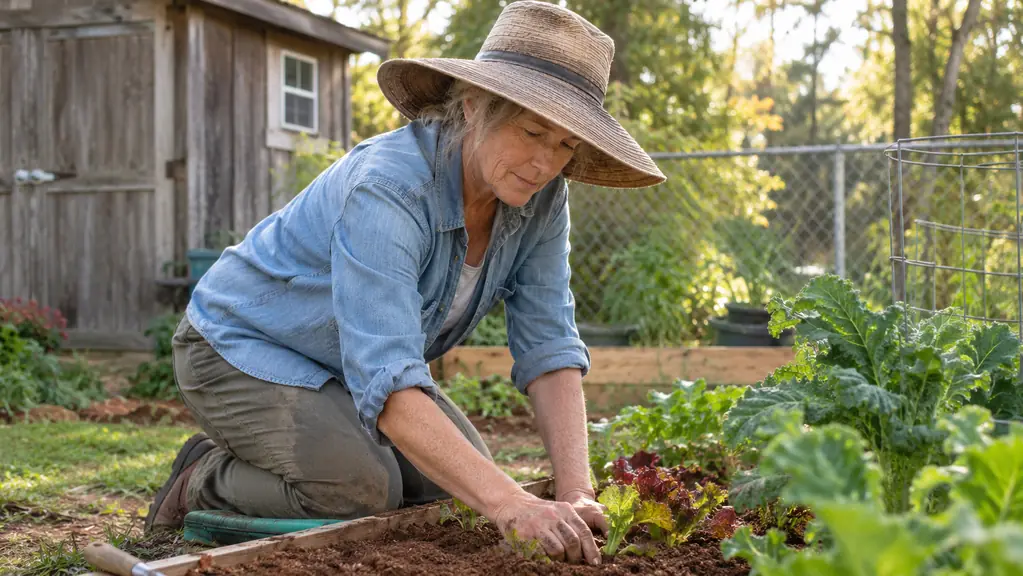
The first spring I gardened this patch of red Piedmont clay, back in 2015, I knelt down in it like it was nothing. Ten years on, kneeling is the part of the garden I plan around. Both my knees get sore and stiff, the right one worse than the left, and my lower back starts in on the bending before the knees do. By the end of the 2024 season I had quit picking the low squash. Left it hanging there and told myself I had planted too much anyway. That is not a gardening decision. That is a quitting decision wearing a gardening hat.
I tried the easy fixes first. A folded towel, which turned into a mud sponge by June. A thin foam pad from the hardware store with the little handle cut into it, which I still own and still use, but only for kneeling on the patio to clean the grill. It helped for about twenty minutes. Then the getting up became the problem. Going down is only half of it. You have to come back up with a packet of seeds in one hand and nothing to push against. That is the job the TomCare garden kneeler and seat does for me. I bought it in March 2025, the first of five things I bought that year, before I had planted a single seed. It helped the first weekend. Two full seasons later it is still the first thing I carry out to the plot and the last thing I put away.
The one thing I bought before I planted anything
Folds flat at 7.6 pounds, no assembly, and the frame gives you something to push against when you stand back up. Two seasons of clay and squash and it still lives by my shed door.
Amazon Check Today's Price on Amazon →Step 1: Put it down before you put anything else down
The mistake I made for six years was carrying the foam pad around with me and dropping it wherever I happened to kneel. Then I would stand up, walk four steps for the trowel, and have to find the pad again. Half the time I just knelt in the dirt. The TomCare fixed that by being too big to misplace. It measures 21.85 inches wide and 11.61 inches deep, 7.6 pounds, and it folds flat, so I set it at the row I am working and leave it there until that row is done.
There is no assembly. That matters more than it sounds. It came out of the box in one piece and the only thing I had to work out was which way to flip it. The legs are sled style, so on the concrete patio it sits flat and the non-slip feet do their job. In the plot it settles into the clay a little, which I like, because it stops the whole thing from skating when I lean on it. I set it on the path between rows rather than in the row itself. The plot is 20 by 12 feet. There is room.
One thing I would tell anybody starting out: decide where you are going to kneel before you decide what you are going to do. I walk the plot first, look at what needs picking or weeding, and set the kneeler at the first spot. Then I bring the bucket and the tools. That sounds fussy. It is not. It is the difference between one trip and four, and four trips across clay is three more chances to lose your footing.
Step 2: Kneel with the pad up and use the frame to stand
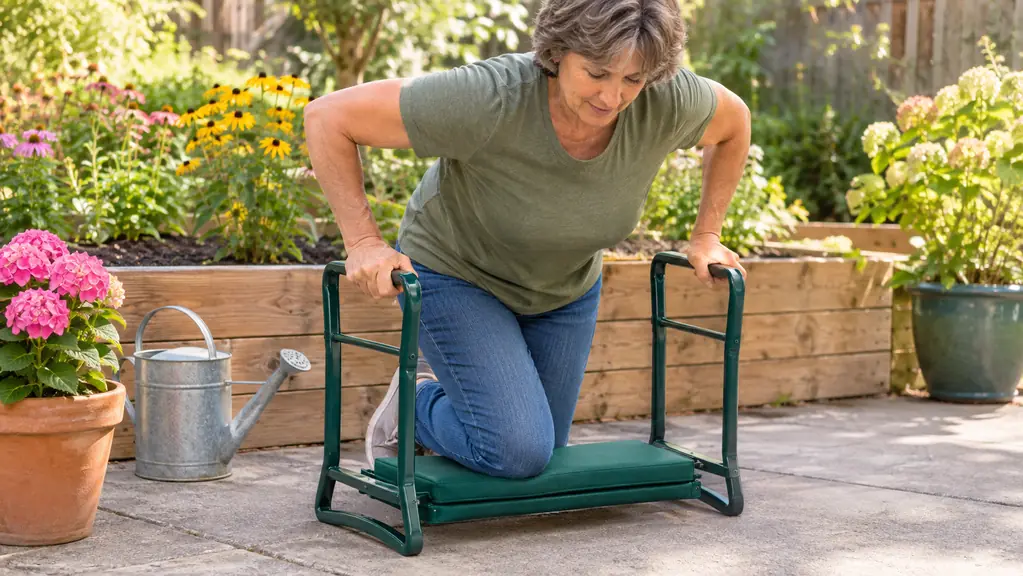
The kneeler has two positions. Pad up, and you kneel. Flip it, and the pad is a seat. Pad up is what I use for weeding, transplanting, and setting out the pepper plants. The pad is 11.12 inches wide, wider than the foam pad it replaced, and both my knees fit on it as long as I square up to it instead of kneeling sideways on the edge.
The part that made the difference is the frame. With the pad up, the rails stand above it like two handles. I put a hand on each one and push. That is the whole thing. I am not levering myself up off one knee with a trowel in the other hand, and I am not rocking back onto my heels to get there. I push straight up on both handles, stand, and then bend down for whatever I forgot. Roy does not garden, so I am not going to pretend somebody is behind me hauling me up by the elbow.
I work in stretches. Fifteen or twenty minutes on the pad, then I stand, walk to the shed or over to the raised bed, and come back. That is not a rule I read anywhere, it is just what my knees tolerate. The kneeler makes the stretch possible because I am not dreading the stand up at the end of it. When standing up is the hard part, you stay down too long. You stiffen. Then it really is hard. Twenty short stretches beats one long one every time.
Step 3: Flip it and sit for the low picking
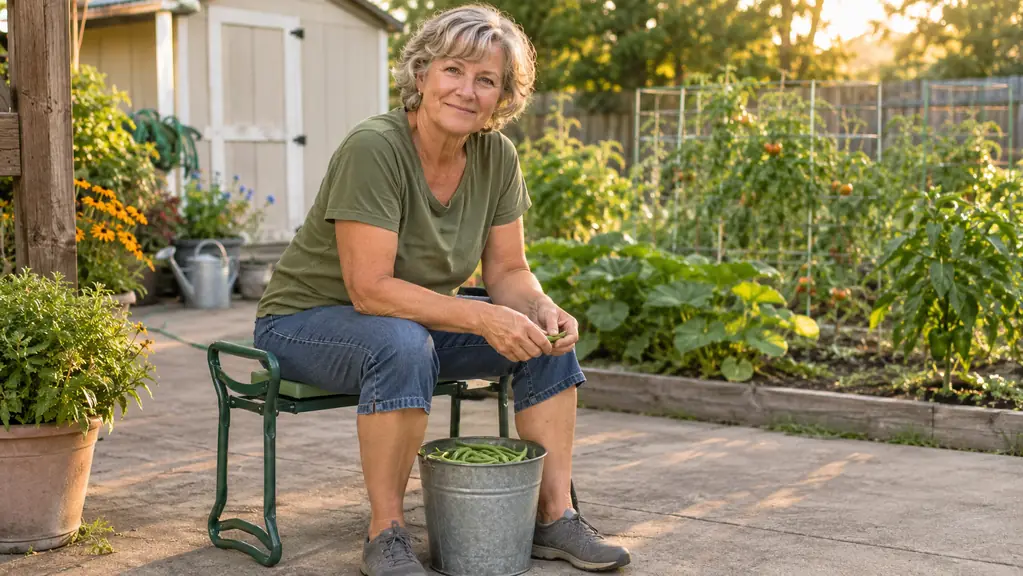
The second position is the one I did not expect to use as much as I do. Flip the kneeler over and the pad becomes a seat at 19.1 inches high, which is about the height of a kitchen chair. So it is a sit, not a squat and not a hover. I use it for the low squash, for the bush beans, and for anything I have to sort into a bucket.
The TomCare frame is rated to 450 pounds. I do not need anything close to that, but it tells you the thing does not flex when you shift your weight, and flexing is what makes a seat feel unsafe at fifty eight. The seat is 11.12 inches wide, same pad, so it is a bench and not an armchair. I sit square on it and lean forward to reach, and I keep the bucket between my feet so I am not twisting around hunting for it.
This is also how the jobs I used to skip get done. Snapping beans goes faster on the seat than standing at the counter, because I can pick and snap in the same spot. When my back starts in, I sit for the picking and stand for the carrying. Splitting one job into two is the whole reason the low half of this garden still gets picked at all.
Going down is only half of it. You have to come back up with a packet of seeds in one hand and nothing to push against.
Step 4: Keep it where the work is, not where it is convenient
It folds flat and it weighs 7.6 pounds, so it is one hand to carry. The TomCare lives in the shed between uses, folded and leaning against the wall by the peg rack where the hori hori hangs. I do not leave it out in the weather. The frame would be fine. The foam would not. That pad is the one part of this thing I have a real complaint about: it shows dirt and scuffs, and it does not wipe clean the way you would hope. A rag and a bucket of water gets most of it. The rest stays.
There are two tool pouches on the frame. Mine hold the twine and a fistful of plant labels. That is all. The hori hori does not go in a pouch, because I wear it on my belt and because I have walked off and left it once already. If you are the kind of person who sets things down and forgets them, the pouches are a good home for the small stuff, but do not expect them to hold a trowel and a drink and a phone at the same time.
Folding flat matters more than I expected. The shed is 8 by 10 feet and it shares space with the mower, a lidded bucket of Tomato-tone, the coiled drip line, and the hose I have had since 2015. A kneeler that did not fold would be a kneeler I resented, and a thing you resent is a thing you stop carrying out. This one tucks against the wall and I forget it is there until I need it.
Step 5: Change the garden so you kneel less in the first place
The kneeler is the fix for the kneeling I still have to do. The bigger fix was to stop doing so much of it. In April 2025 I put a raised bed at the south edge of the patio, 72 by 24 by 30 inches. I assembled it myself on a Saturday in about two hours with a screwdriver, and Roy helped me lift it onto the patio once it was together. It holds leaf lettuce, spinach, radishes, green onions, bush beans, basil and parsley. Every bit of that I plant and pick standing up.
That is the part people miss when they buy a kneeler. It does not make the ground higher. It makes the ground reachable. If you can move half your crops up to waist height, you only need the kneeler for the other half. My tomatoes stay in the plot and always will, Better Boy and Cherokee Purple, six plants. The raised bed is a supplement, not a replacement. I still garden the 20 by 12 plot every single year, and I still pull weeds out of that clay by hand.
The other change is smaller than either one, and it is the one I would keep if somebody made me give the rest back. I carry a bucket for weeds at hip height instead of setting it on the ground, so I am not bending to drop a handful of crabgrass. I keep the twine in the pouch instead of in the shed. I do the low work in the morning before the heat and the standing work in the afternoon. None of that is equipment. It is arranging the day so the hard part is short.
What Else Helps
A hori hori. I bought the Nisaku in June 2025, the last of the five things, and it replaced a stamped steel trowel whose neck bent in this clay back in 2024. It rides on my belt in the sheath. When the tool is on your belt you do not stand up to go get it, and standing up to go get it is how a fifteen minute job turns into a forty minute job.
Watering that does not involve dragging. I ran a drip line in May 2025, 100 feet of quarter inch tubing with 16 adjustable nozzles, 6 on the raised bed and 10 in the plot. I turn the spigot on by hand every morning for about 25 minutes in summer and turn it off. Nothing to program, nothing to learn. What it replaced was a 50 foot hose I dragged around every evening since 2015. The hose is still in the shed for washing things. Doreen two doors down waters with a soaker hose and hers works fine, so I am not going to tell you one is better than the other. I will tell you that not dragging 50 feet of hose across a garden is easier on the knees than dragging it.
The rest is not equipment. A five gallon bucket turned upside down is a seat if you are in a hurry. A patio chair at the edge of the bed saves a walk. Twenty minutes of low work, then the standing work, then back down if there is more. And being honest with yourself about which jobs you have already started skipping, because that list is the thing you are actually trying to fix. Mine had squash on it, and it took a whole season to admit that out loud.
Two seasons, and I still carry it out first
Pad on one side, seat on the other, and a frame to push against when you stand. Mine has been out to the plot and back to the shed more times than I could count since March 2025.
Amazon Check Today's Price on Amazon →