
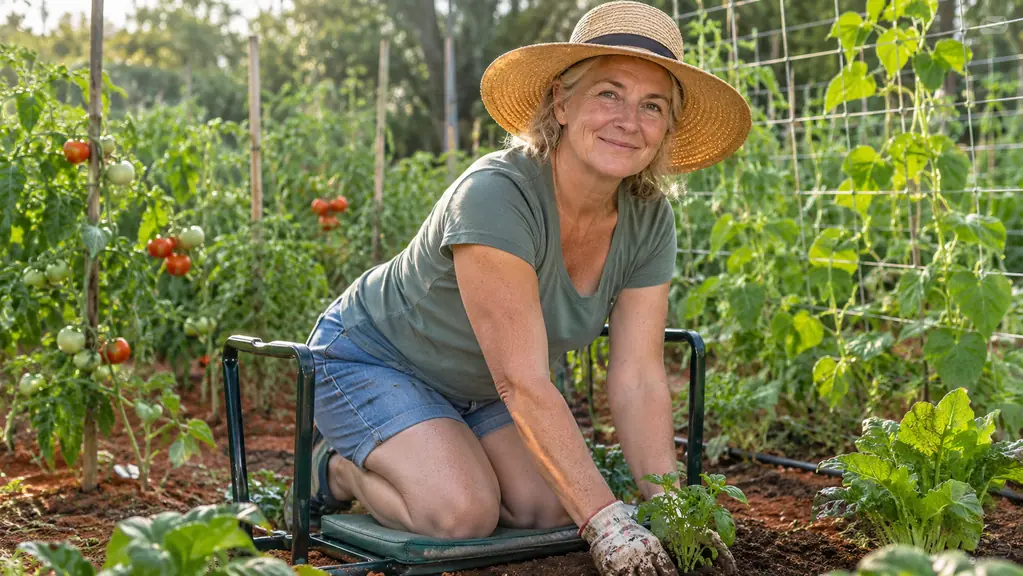
I bought the TomCare garden kneeler and seat in March of 2025, about three weeks before I set the first Better Boy out, and I want to be honest about why. It was not comfort. It was that I had started planning my weeding around how hard it would be to stand back up. My plot is 20 by 12 feet of red Piedmont clay behind the house, and the first warm week of April always turns it into a mat of chickweed and henbit. I had a thin foam pad for that job since about 2019. The pad did nothing about the standing up.
Two full seasons later it is still the first thing I carry out and the last thing I bring in. Both knees are sore and stiff, the right one worse than the left, and my lower back tires before my hands do. I am 58 and retired from dispatching school buses, so I have the time to garden and not always the joints for it. That is the trade this thing is really selling, and for me it decided whether a morning in the plot lasted two hours or forty minutes.
The Quick Verdict
It gets me down to the soil and back up without using my knees as a lever, and the seat earns its place. It is a perch rather than a chair, though, and the foam will look like the garden by June.
Amazon Check Today's Price →The tool I reach for before my knees touch dirt
TomCare's kneeler flips from a kneeling pad to a bench seat, folds flat for the shed, and needs no assembly at all. Two seasons in, it is the one piece of garden gear I would replace tomorrow if it walked off.
Amazon Check Today's Price on Amazon →How I've Used It for Two Seasons
When I am working the plot I carry it out with the pouches already loaded, twine in one and plant labels in the other, and I set it down where I mean to start. Pad side up, I kneel with the frame in front of me and both hands on the crossbar, and when I have worked that patch clean I push down on the frame and stand. Nobody needs a demonstration of that part. What surprised me is how much more weeding I do in one pass now, because getting up is no longer the thing that ends the session.
The first Saturday I had it out, I worked the whole east side of the plot in one go, from the first tomato stake down to the corner where the squash goes. That is maybe eighteen feet of row. With the foam pad I would have done six feet and stood up to stretch my back, then done six more. I finished the eighteen feet before the dew was off the beans, and then I went and did the west side too, which I had not planned on. That is the honest measure of the thing: it did not make the weeding easier, it made the weeding longer, because I stopped quitting.
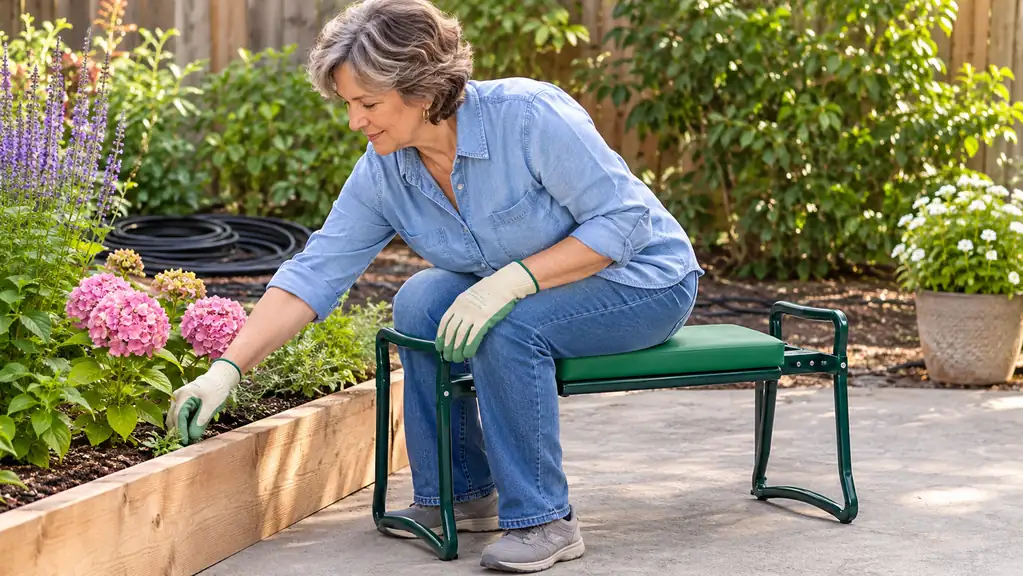
Then I flip it. Sitting on it at nineteen inches puts my hands right where the lowest pods are, and last summer that is where I picked most of the pole beans and all of the yellow squash. It does not tip when I lean forward, which I put down to the sled feet sitting flat on the clay instead of digging in. I have leaned further out than I expected to and it has not handed me my hat yet. Roy watched me do it once and said it looked like a milking stool, which is close enough.
I use it every week from April through October, and more often in July when the squash needs picking every other day. It also turned out to be the tool for setting out transplants, which used to be the worst job in the plot because it is nothing but bending and standing, bending and standing. I set six tomatoes and the peppers that way last spring and did not have to go lie down afterward. That is a small thing to read and a large thing to live through.
What Nobody Tells You: It Is a Perch, Not a Chair
If you are picturing a chair, stop. The seat is a pad on a steel frame with no back and no arms, and nineteen inches is kitchen stool height, not porch chair height. That is fine for leaning forward and picking. It is not where you settle in with a glass of tea and survey your work. I tried it, and after about ten minutes my lower back wanted the frame to have a back on it, and the frame does not.
The second thing nobody says is that flipping it is a separate motion. You kneel, you work, you stand up, you turn the thing over, you sit down. If what you want is to go from kneeling to sitting without standing in between, this does not do that. What it does is give you two useful positions instead of one, and I will take that, but the pictures make the changeover look smoother than it is.
There is a way around it. If I know I am going to pick after I weed, I set the thing down pad-up, do the weeding, stand, flip, and sit, and I have not lost anything. What I stopped doing is flipping it back and forth in the middle of a job. Twice on one morning is fine. Six times is a workout, and I already have a garden for that. So the practical answer is to plan the order of the work: weed first, pick second, and flip once.
The third is the foam. It is EVA foam, wide and soft enough that my knees do not complain, and it holds dirt the way a screen door holds dust. By the end of June the middle of mine is a different shade than the edges. I have hosed it off twice and it does not come all the way back. That is my one real complaint and it is cosmetic. It has not changed how the pad feels or how well it has held up.
The Pad, the Frame, and the Parts That Earn Their Keep
The pad is 11.12 inches wide, which sounds like a number until you have knelt on one that was not. My old foam pad was narrow enough that a knee would slide off the edge every time I shifted my weight, and I spent more time repositioning than weeding. At this width both knees stay on it even when I lean to one side for a weed just past my reach. If you take nothing else from this review, take that. The width is the feature.
My old pad was about an inch of foam, and after twenty minutes my knees would find the clay through it. This pad is thick enough that I do not think about my knees at all while I am down there, which is the point. I have knelt on it on wet ground in May and on hard dry clay in August and it feels the same either way. That is the difference between a pad and a kneeling tool, and it took me a season to understand it.
The frame measures 21.85 inches across and the seat sits at 19.1 inches off the ground. The width is what makes it feel steady under a person my size, and the frame is where your hands go when you push back up, so it needs to be rigid. It is. I have put my full weight on that crossbar every week for two seasons and there is no give in it and no flex at the joints. The non-slip feet sit flat on clay and on concrete both, which is more than I can say for most folding things.
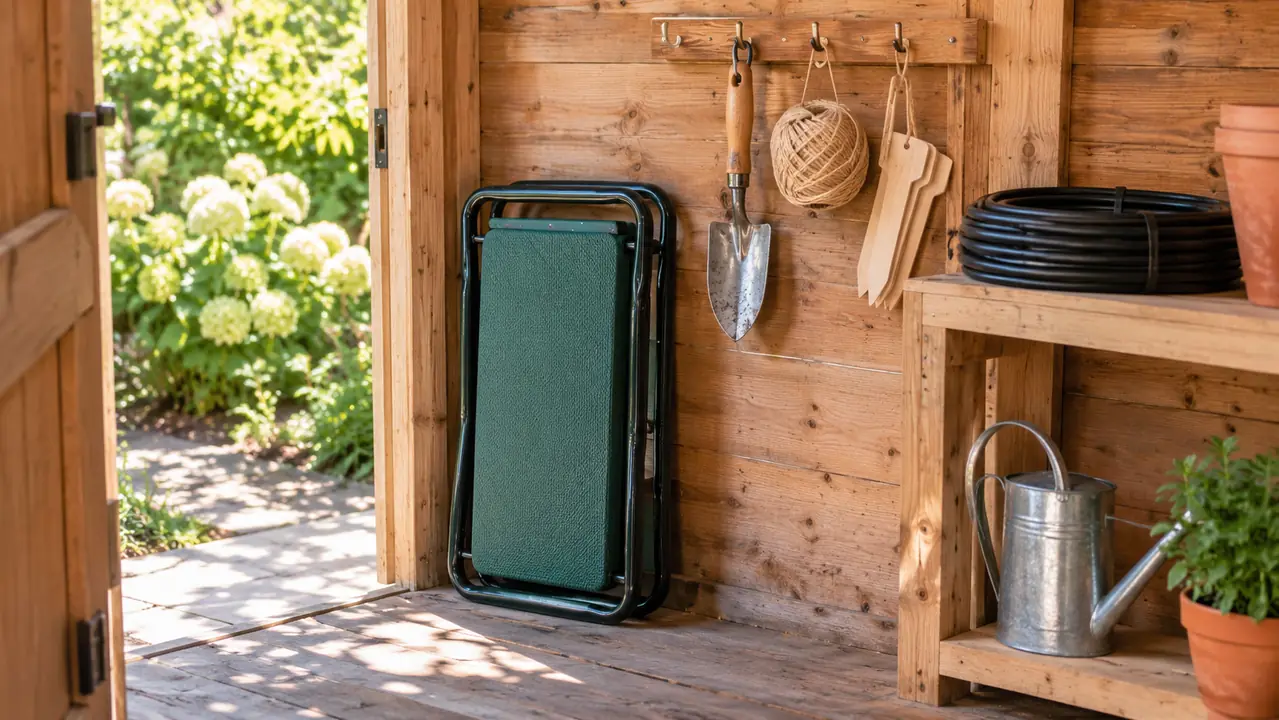
TomCare rates the frame to 450 pounds and lists the whole thing at 7.6 pounds. I am not going to be the one who tests the first number, but the second one matters more than I expected. It is light enough that I carry it one handed out to the plot with the pouches swinging, and heavy enough that it does not skitter across the patio when I push off it. Folding it flat takes a second, and it stands on its own against the shed wall.
The two tool pouches are the parts I did not expect to use and now would miss. Mine hold twine and plant labels and nothing else, which is enough. My hori hori stays on my belt in its sheath, because a pouch is not where I want a blade while I am pushing myself up off a frame. But for the twine, the labels, a pen, and whatever seed packet I am working from that morning, they are exactly right, and they hang where I can reach them from either position.
Getting down is not the hard part. I am on that pad at eight in the morning and back on my feet without pushing off the dirt with my hands, and that is the whole reason I bought it.
Where It Belongs in My Garden and Where It Does Not
I do not use it at the raised bed. That bed sits 30 inches off the patio, so the entire point of working there is that I do not bend at all, and the kneeler would just be something to trip over. It stays on the ground where the ground work is: the plot, the edges of the plot, and the weeds that come up between the tomatoes where nothing else will reach.
The other place it goes is the patio. I clean the grill out there a couple of times a summer, and the old foam pad still does that job, mainly because I am already down there and there is only one thing to get up onto. That is a fair summary of the difference between the two. The foam pad is fine when you get up once. The TomCare is for when you get up eleven times before lunch.
Where it does not belong is anywhere you have to carry it a distance. It folds flat and it is not heavy, but it is not a thing you sling over a shoulder for a walk to the back fence. Mine lives in the shed and moves about forty feet, twice a day, and that is its whole commute. If your garden is spread out and your tools live on the far side of it, think about that before you buy.
Flipping It, Carrying It, and Living With It in a Shed
It folds flat and stands against the wall of the shed beside the peg rack, which is where it lives from November through March. Because there is no assembly, I was using it ten minutes after I cut the box open, and after two seasons nothing has loosened, rattled, or worked its way out of true. If you have ever spent a Saturday with an allen wrench on something that was supposed to save you time, that is worth noting on its own.
The shed is 8 by 10 foot and it is not empty. There is the mower, two bags of Tomato-tone in a lidded bucket, the drip tubing coiled on a shelf, and a peg rack with the hori hori and the twine. The kneeler folds to about the width of the frame and stands in the gap between the peg rack and the corner, and it has never been in the way. That sounds like a small thing until you have owned a garden tool that has no home and ends up leaning against the house.
Two Piedmont summers is the test I can speak to: heat, humidity, and a shed that gets to ninety five degrees inside by August. The frame has not rusted, the pad has not cracked, and the feet have not worn through. The only part that has aged is the look of the foam, and it aged in the first month. I cannot tell you how it would do left out in the rain all summer, because mine has never been left out.
The one thing I would tell a friend before they set it down is to get all four feet flat before they commit their weight. The feet are stable on clay and on concrete, but they want to be square to the ground, not half on the edge of a bed. I figured that out the first morning and it has not been an issue since. That is not a flaw in the design, it is just how you use a thing that stands on feet.
What I Liked
- Getting up is a push on the frame instead of a scramble off the ground.
- Two positions in one tool: kneel on the 11.12 inch pad, flip it, sit at 19.1 inches.
- Wide enough that both knees stay on the pad when I lean to one side.
- No assembly. I was using it ten minutes after the box came open.
- Two pouches that actually hold the twine and labels I need that day.
- Folds flat and stands against the shed wall without leaning on anything.
Where It Falls Short
- The foam holds dirt and scuffs and does not wash back to new.
- It is a perch, not a chair. No back and no arms.
- You have to stand up to flip it, so it is not a seamless move from kneeling to sitting.
- At 7.6 pounds it is a shed to plot tool, not something to carry to the back fence.
Who This Is For
This is for the gardener whose knees have started making decisions for them. You know the ones. You plan the weeding around how many times you will have to stand up, you leave the low work for last, and you find reasons to put it off until the vines are in the way. If that is you, this is the simplest fix I know of, and you will notice it the first morning rather than the first month.
It also suits anyone who does two kinds of low work in the same session: kneeling to weed or set out transplants, then sitting to pick low pods, squash, or strawberries. That is most of what I do from April through October, and the two positions cover all of it. It has held up on my concrete patio and in the clay plot equally well, and I have not had to think about where I set it down.
Who Should Skip It
If every crop you grow is in a raised bed, skip it. Standing at 30 inches is easier than kneeling at nothing, and this tool would have no job in that garden. That is not a knock on it. It is a tool built for one kind of work, and I would rather tell you that than have it sit in your shed next to mine.
If what you want is a chair to sit in while you pick, buy a chair with a back. And if you already have a foam pad you are happy with, and you only get down once a morning, that pad is doing the same work with less to store. The TomCare earns its space when you go up and down all morning. That is the honest dividing line, and it is the reason I still have both.
Two seasons in, it is still the first thing I carry out
If getting back up is the reason you quit early, this is the fix I found that does not involve putting every crop in a raised bed. Folded, it takes up less shed wall than a broom.
Amazon Check Today's Price on Amazon →