

For ten years I watered a 20 by 12 foot vegetable plot with a 50 foot hose. Every evening from May to September. Drag it out, walk the rows, stand there with my thumb over the end of it, drag it back. My right knee has been stiff since before I retired and my lower back tires from bending, and neither one thought much of that hose.
In May 2025 I bought a MIXC drip irrigation kit and spent one afternoon on my hands and knees running tubing through red clay. Two full seasons later I water the in-ground plot and the raised bed off that same kit, every morning, and I have not gone back to the hose. What follows is why, in the order it actually matters to somebody with sore knees and a garden to keep alive.
Ten nozzles in the plot, six in the raised bed, one spigot
That is the entire system. 100 feet of 1/4 inch tubing, 16 adjustable nozzles on bendable rods, and a habit I picked up in one afternoon.
Amazon Check Today's Price on Amazon →Twenty-five minutes at the spigot instead of an hour on my feet
The hose took the better part of an hour, because I had to stand over every row holding it. Now I walk out, open the spigot, and glance at the clock. After about 25 minutes I walk back out and close it. That is the whole job. I do it before the heat comes up, and by the time I have finished my coffee the plot has had its water. Nothing else in the garden gives me back that much standing.

One system waters both the plot and the raised bed
I used all 100 feet and all 16 nozzles: six out at the raised bed on the patio, ten in the in-ground plot. That was the part I did not expect. I figured the raised bed would stay a watering can job forever. The tubing runs from the one spigot on the back wall, splits at the patio, and both beds are watered in the same 25 minutes. One job instead of two, which matters more than it sounds like it does.
The nozzles aim at a plant, not at a whole row
Each nozzle sits on its own bendable rod and turns 360 degrees independently. So the tomato at the end of the row gets its water and the walkway beside it stays dry. I move two of them in June when the squash spreads out and starts shading things. That is the only adjustment I make all season.
Nothing to charge, nothing to pair, nothing to remember
The MIXC kit runs on water pressure, rated to 60 psi, and that is all of it. No timer, no battery, no app on my phone that I would have to keep up with. My neighbor Doreen has a soaker hose and likes it fine and I am not going to argue with her about it. I just know that I turn a spigot with my hand every morning and I have never once had to think about the system itself.
No more hauling a watering can down a row of tomatoes
Before the drip line, any row the hose could not reach got a watering can, and a full can gets heavy by the third trip. There is no can in my garden now. The far end of the plot waters itself while I am standing at the spigot doing nothing. My lower back notices the difference by August, which is the month it used to complain the loudest.
The middles between rows stop turning to mud
Dragging 50 feet of hose through the plot every evening wore a wet path down the middle of everything. Watering cans sloshed. By July that soil was packed and slick and I was kneeling in it. Now nothing crosses those middles. The water lands at the base of the plants and the ground I walk on stays where it belongs, which also made weeding easier without my ever planning for that.
You can see where the water is going
I like that I can look at it. You open the spigot, watch for a few seconds, and you know whether a nozzle is pointed at the plant or at the fence post. If one is off, you bend the rod and it is done. Nothing is buried and nothing is hidden behind a panel. A thing you can see is a thing you can correct, and I have corrected plenty of small things in two seasons.
Three hours on a Saturday, mistakes included
The MIXC kit went in one afternoon, about three hours, on my knees in the clay. Day one a connector dripped. I pushed the tubing further in, it stopped, and it has not leaked since. The maker suggests no more than eight rods per 50 feet of tubing, so I laid mine out with that in mind. Two seasons of daily use and I have replaced nothing.
It comes up in November and goes back down in April
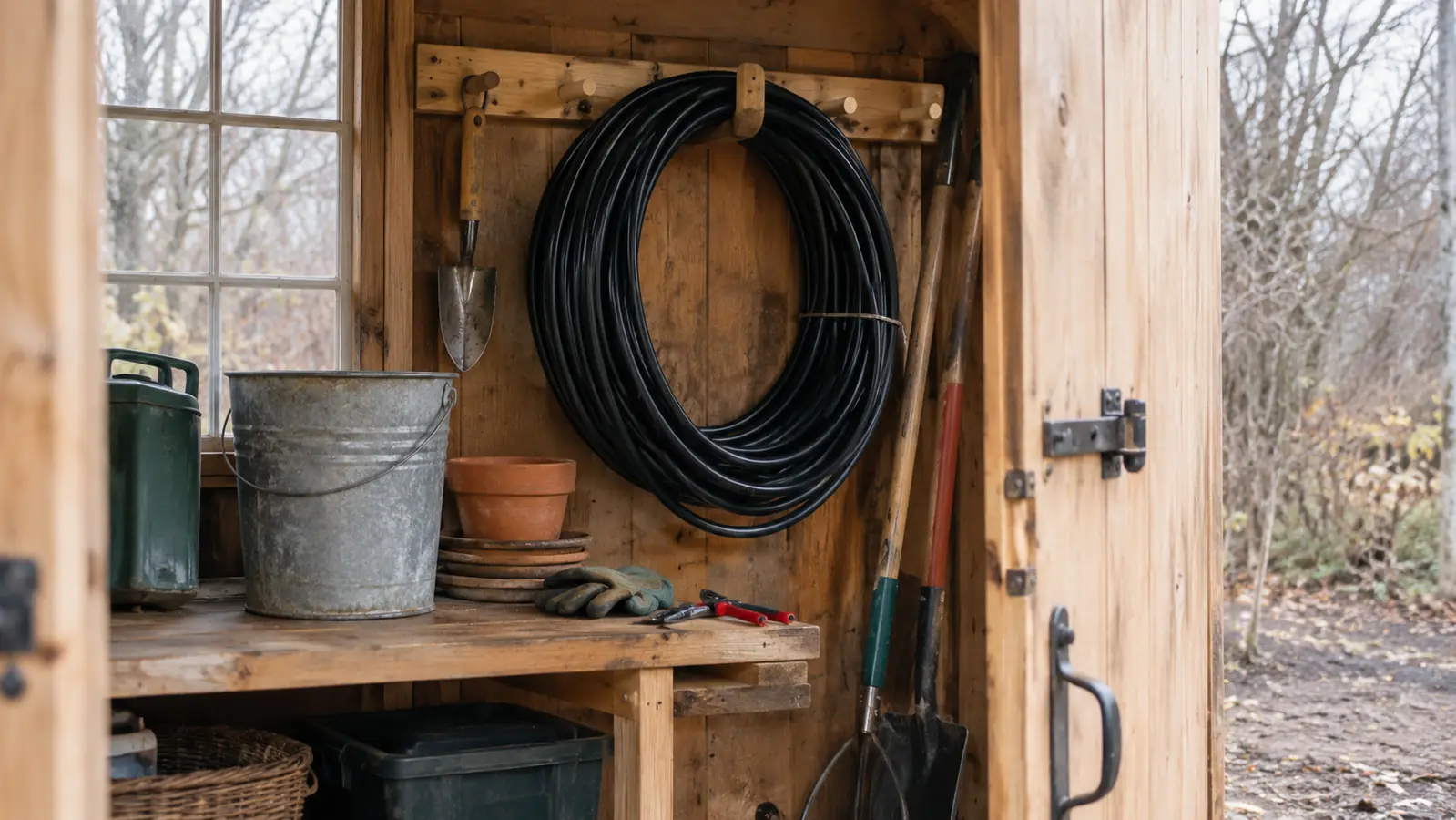
I drain it, coil it, and hang it in the shed before the first frost, which here runs around late October. In April I lay it back out. Maybe an hour of work twice a year. The rest of the time it sits on the soil doing its job and I do not think about it at all, which is the highest praise I can give a garden tool.
The raised bed stops drying out in the middle of July
That bed dries out faster than the ground does once the heat sets in, and it was the reason I ran a line out there in the first place. Six nozzles on a bed that size is more than enough. In July, when the plot is wilting by two in the afternoon, the bush beans and the basil in that bed are still upright, and I have never once carried a can out to them.
The hose took me the better part of an hour. The drip line takes twenty-five minutes, and I spend twenty-four of them in the house.
What I'd Skip
I would skip the timer. I know that is the first thing people add and I understand why, but I am out at the spigot every morning anyway and a timer would be one more thing sitting there failing while I am not looking at it. I would skip buying more nozzles than the garden can use, since 16 covered a 20 by 12 foot plot plus a raised bed with a few to spare. And I would skip watering in the afternoon. Open the spigot in the morning, set the timer on the stove for 25 minutes, walk away. That is the whole method and it has held for two summers.
Two seasons in, it still goes back out every April
The MIXC kit has run daily on my plot and my raised bed since May 2025. Same tubing, same nozzles, nothing replaced.
Amazon Check Today's Price on Amazon →