

I gardened in red Piedmont clay for ten years before I bought a drip kit. That means ten years of dragging a fifty foot hose around six tomato plants every evening, standing there with my thumb over the end of it, moving the spray back and forth like I was putting out a small fire. My knees would be sore by the time I finished. Half the water landed on the leaves and the bare ground between rows instead of down where the roots could use it.
In May of 2025 I bought the MIXC drip irrigation kit, the 100 foot set with 16 adjustable nozzles, and I laid the whole thing out myself in one afternoon. Two full growing seasons later it is still what waters my garden, both the 20 by 12 foot plot and the raised bed out on the patio. I am 58 and retired from dispatching school buses, which is a job that teaches you to notice when a thing is running late. This kit has not been late yet. Here is what two seasons with it actually looked like, including the part on day one when a connector dripped on my shoes.
The Quick Verdict
A plain 100 foot drip kit that puts water at the roots instead of on the leaves. Two seasons on, the tubing and the nozzles are still doing their job. Plan on an afternoon for setup and a firm hand with the connectors.
Amazon Check Today's Price →100 feet of tubing, 16 aimable nozzles, one afternoon
The MIXC set covered my plot and my raised bed both. Six nozzles went to the lettuce and spinach, ten went out to the tomatoes and peppers. Rated to 60 psi and driven by plain water pressure, with nothing to charge and nothing to program.
Amazon Check Today's Price on Amazon →How I've Used It
I installed it in May 2025, on a Saturday, and it took about three hours including the time I spent standing in the shed doorway deciding where to run the main line. I used all 100 feet and all 16 nozzles. Six nozzles are on the raised bed at the south edge of the patio. The other ten are out in the in-ground plot, spaced down the two rows of tomatoes and around the peppers and squash. The maker suggests no more than eight rods on any 50 feet of tubing, and I followed that, which is why the run out to the plot has a little slack in it instead of being pulled tight.
My routine has not changed in two years. I walk out in the morning, turn the spigot on by hand, and go back inside. About 25 minutes later I walk out and turn it off. That is the whole system. There is no timer on it and I have never added one. Some mornings I forget until the squash leaves are drooping and I go out at nine instead of seven, and the plants forgive me. In July I do it seven days a week. In September, when the nights cool off, I cut back to every other morning.
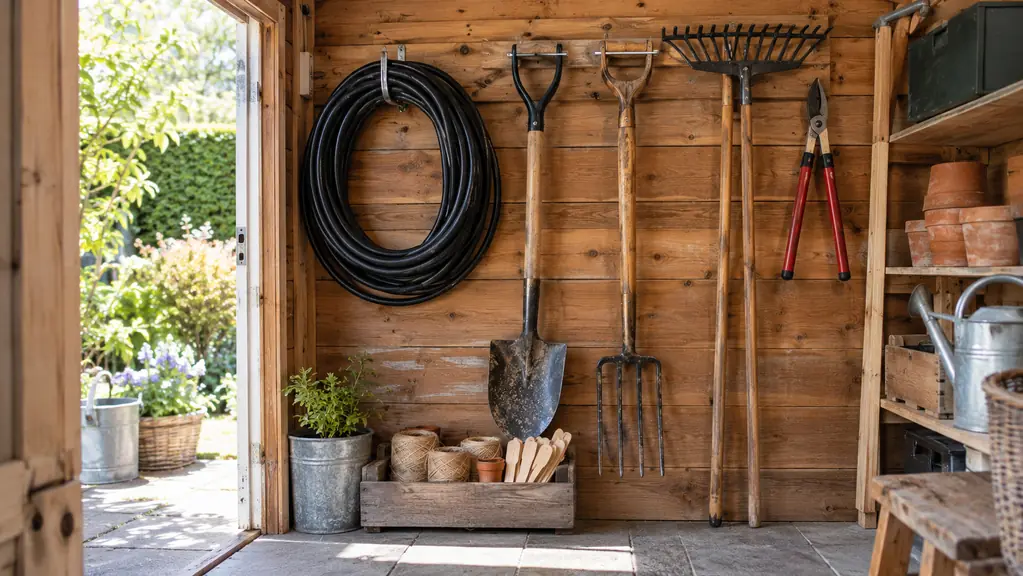
In November I disconnect it, drain the tubing, coil it, and hang the coil in the shed by the back fence. In April I lay it back out. Two Novembers and two Aprils so far, and nothing has cracked or split. The rods come off the nozzles and go into a coffee can so they do not get bent against something in the shed over the winter. That was Roy's idea, my husband, who does not garden but is good at storage.
What Came in the Box and How the Afternoon Went
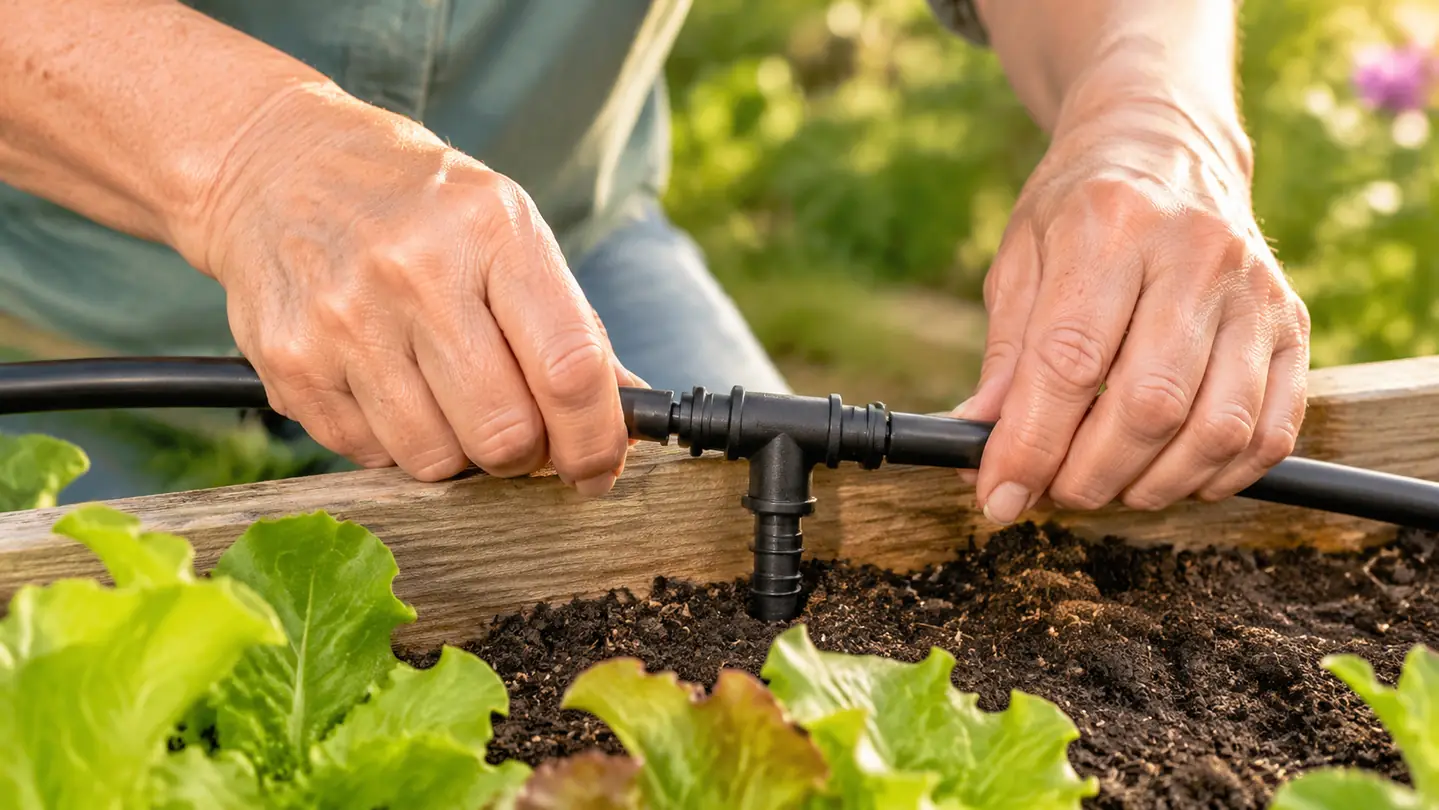
The MIXC box gives you 100 feet of 1/4 inch tubing, 16 nozzles already mounted on bendable rods, and the connectors to join it all together. The nozzles are metal, not plastic, and each one turns by hand so you can set the pattern from a narrow stream to something wider. The tubing itself is plastic and it is going to sit out in the sun, which I have made my peace with. The rods bend and hold where you put them, which matters more than I expected it to.
The first afternoon was mostly pushing tubing into connectors. You cut the tubing with a utility knife, you push it into the fitting, and you push harder than feels necessary. I did not push hard enough on one connector near the raised bed, and it dripped down the side of the bed for the first ten minutes until I seated it deeper. That was the only leak I have had. Nothing has come apart since, including through two winters of being coiled and stored and two springs of being dragged back out.
There is no clever trick to the layout. You walk your garden, you decide where the plants actually are, and you cut tubing to reach them. I did it with a pair of hedge shears holding one end down and a notebook in my back pocket. The only place I had to stop and think was the corner where the line turns from the patio out toward the plot, and I gave that corner extra slack because I could tell it was going to get stepped on. It gets stepped on. It has held. If you have ever run an extension cord around a room to figure out where a lamp goes, you can do this.
The Nozzles Are the Reason It Works
This is the part that separates a drip kit from a soaker hose, and I say that as somebody who has never owned a soaker hose but has watched my neighbor Doreen water with one for years. Hers sweats along its whole length and waters a strip. Mine puts water in 16 specific places, and I pick the places. The nozzle at the base of my Cherokee Purple is bent down and turned low. The one at the edge of the lettuce gets a wider pattern and less flow. You can aim them at the plant and not at the aisle between rows, and that is the whole difference.
Adjusting them takes a minute each and you do it with your fingers, no tools. Early on I had two nozzles turned up high enough that they splashed mud onto the lower pepper leaves, so I turned them down. Later in the summer, when the tomatoes got big and were drinking more, I turned those two back up a little. That kind of tuning is not something the box tells you to do, but it is the reason the kit has stayed useful for two seasons instead of annoying me.
One thing to know before you buy: all 16 nozzles run at once, off one spigot. There is no dividing it into zones. If the raised bed needs less water than the plot, you adjust the individual nozzles rather than turning off a section, or you turn the whole thing off sooner. For a garden my size that has not been a problem, because the plot and the bed both want water in July and neither wants much in October. On a bigger garden with different crops on different schedules, you would want to split it into two runs.
Two Seasons in the Ground
The first summer I kept waiting for something to fail. Plastic in a North Carolina July is a hard test, and I figured the tubing would go brittle by August. It did not. The rods were what I expected to break, and one of them has a kink in it now from where Roy stepped on it in the dark, but it still bends and still holds its aim. The nozzle on it still turns. That kink is the only damage in two seasons and it is our fault, not the kit's.
The raised bed is where the drip line earned its keep faster than I expected. That bed sits up off the ground on the patio, out in the open, and the soil in it dries out fast in July. Before the drip line ran out there I was carrying a watering can to it every single evening, and both knees had an opinion about that. Now a line runs along the top and six nozzles handle it, and I do not carry the can unless I am watering in a new transplant.
One more thing I noticed and did not expect. With the hose I wet the leaves every evening whether the plant needed it or not. With the nozzles down at the soil line, the foliage stays dry. I am not going to sit here and tell you that stopped this or prevented that, because I have not run the experiment and I am not going to pretend I have. I noticed fewer mildewed squash leaves in 2025 than in 2024. That is what I noticed. It is not proof of anything.
What it has not done is fix my clay. Water delivered slowly at the root is still water sitting on top of clay, and the plot still puddles in the low corner after a hard rain. The kit does not aerate anything, does not feed anything, and does not change the soil. It only moves water from the spigot to the plant without me standing there holding a hose. That is a smaller claim than some of the reviews make, and it is the one I can stand behind.
The other honest limit is the first week of a transplant. A new tomato or a new pepper gets hand watered with a can for about a week no matter what the drip line is doing, because a young plant does not have the roots to reach what the nozzle gives it. After that week the kit takes over. Anybody who tells you a drip line replaces all hand watering has not put a transplant in the ground in July.
What I Liked
- Puts water at the soil line instead of on the leaves
- 16 nozzles on bendable rods, each one aimable and adjustable by hand
- All 100 feet and all 16 nozzles covered my plot and the raised bed with none left over
- Coiled into the shed two Novembers and laid back out two Aprils with nothing cracked
- Runs on plain water pressure, so there is nothing to charge and nothing to plug in
- Setup took one afternoon and no help
Where It Falls Short
- Connectors need a firm push, and one dripped on day one until I seated it deeper
- All 16 nozzles run off a single spigot, so there are no separate zones
- You turn the spigot by hand, morning and evening in the middle of summer
- Plastic tubing and plastic rods will not last forever in the sun
- Nozzles at the far end of a long run will be weaker than the ones near the spigot
It took three hours to lay out, it leaked once on the first afternoon, and it has not leaked since. That is two full growing seasons.
What It Doesn't Do
No timer. The kit runs on plain water pressure off the spigot and you turn the spigot by hand, which means if you are going to be gone for a week, somebody has to come turn it on and off or the garden gets nothing at all. I have had Doreen from two doors down do it twice. She waters her own garden with a soaker hose and thinks I am fussy about mine. That is fine. If you want a system that runs itself, that is a different purchase and you should plan on making it.
It also does not push much. This is a 1/4 inch line rated to 60 psi, and the flow out of any one nozzle is gentle by design. If your spigot sits at the far end of a long run, or your water pressure is low to begin with, the nozzles at the end of the line will be weaker than the ones near the spigot. Mine are all within 100 feet of the spigot so I have not had to deal with it, but I can see how somebody would.
And the plastic is plastic. I expect to be buying another set someday. I do not expect it to be this year, and I would not be surprised if it were three or four years out rather than two. But there is no version of this where a 100 foot length of 1/4 inch tubing left out through a North Carolina summer lasts forever, and I would rather say that now than have you find out in year four and blame me.
Who This Is For
This is for somebody with a garden in the ground or in raised beds, a spigot within 100 feet of it, and a body that has started to complain about the evening hose. That was exactly my situation. I have a 20 by 12 foot plot and one raised bed, and 100 feet with 16 nozzles covered both with nothing left over and nothing missing. If you are watering pots on a porch, the same kit will run out there. If you are watering half an acre, it will not.
It is also for somebody who does not mind walking out to the spigot twice a day. That is the trade. You are not buying automation, you are buying the end of standing there with your thumb on a hose while the mosquitoes find your ankles. For me that was worth an afternoon in May and a coil in the shed every November. I still go out to the garden in the morning. I just do not stay out there.
Who Should Skip It
Skip it if you want a system that turns itself on. This one does not, and no amount of wanting will change that. Skip it if your garden is big enough that you would need two or three of these, because at that point you are running several spigots or splitting zones and you should be shopping for a kit built to do that. Skip it if your water pressure is weak or your spigot sits far from the beds, because the far end of the line will disappoint you. And skip it if you like the evening walk out with the hose. There is no shame in that. Some people find it restful. My knees retired from restful in 2024.
Two seasons in, and I would buy it again
The MIXC set is 100 feet of 1/4 inch tubing with 16 adjustable nozzles on bendable rods, rated to 60 psi off whatever pressure your spigot gives it. Lay it out once in the spring and coil it away in the fall.
Amazon Check Today's Price on Amazon →