

If you have a raised bed and a spigot on the back wall, the MIXC drip irrigation kit waters it better than a soaker hose. If you have a long strip of ground and you want to lay something down and forget it, the soaker hose is the easier thing to live with. That is the short answer, and I will spend the rest of this page showing you why I landed there after two full seasons.
I am not an expert and I am not selling anything. I am 58, retired from dispatching school buses in Asheboro, and I garden a 20 by 12 foot plot of red Piedmont clay plus one raised bed on the south edge of my concrete patio. In May of 2025 I bought the MIXC drip kit and installed it myself in an afternoon. My neighbor Doreen, two doors down, waters with a soaker hose. I have never owned one. Everything I say about soaker hoses comes from standing in her yard and looking at hers, which I think is worth being plain about up front.
| MIXC drip kit | Soaker hose | |
|---|---|---|
| Where the water goes | Sixteen adjustable nozzles on bendable rods, each aimed at the base of a specific plant | Water seeps along the whole length of the hose, wherever it happens to lie |
| Aiming at one plant | You turn a nozzle and it points where you point it | You move the hose, or you don't |
| Raised bed | Runs a line up and over to six nozzles and covers the whole bed in one pass | Lays across the surface, competes with the plants for space |
| Long straight rows | Possible, but you have to place a rod every few feet | One hose, one run, done |
| Cost to get started | Higher. You are buying tubing, nozzles, rods and connectors in one box | Lower. It is a hose |
| Setup time | About three hours for me, first time, 100 feet and 16 nozzles | Minutes. Lay it down, hook it up |
| Clogging | Nozzles are adjustable and can be turned up to clear, or unscrewed | Pores clog with mineral scale and there is nothing to take apart |
| Seeing whether it is working | You can watch each nozzle spray and count them | You kneel down and feel the soil, because the surface looks wet either way |
| Winter storage | Drain it, coil it, hang it in the shed | Roll it up, and old ones tend to crack |
| Knees and back | Set it up once in spring and never bend to it again | You are moving it and checking it by hand |
Before I get into the two lists below, look at that table again. There are four rows where the soaker hose wins or ties, and I put them there on purpose. A comparison where my kit takes every line would be a sales pitch, and you can get one of those anywhere.
Where the MIXC Kit Wins
The MIXC kit wins on aim, and aim is the whole ballgame in a bed. It came with 100 feet of quarter inch tubing, sixteen adjustable 360 degree nozzles on bendable rods, and the connectors. I used all of it: six nozzles on the raised bed, ten in the plot. Each of those sixteen can be turned to point wherever I want it, so I point them at the base of a plant instead of at the leaves. Doreen's soaker hose waters the strip of soil it is lying on. If a tomato plant is eight inches off that strip, it gets what seeps sideways, and clay does not seep sideways kindly. I know that because I tried the other way first. From 2015 up until that May I dragged a 50 foot garden hose around the plot every evening after supper, stood on the end of it with my thumb over the opening, and got water on the leaves and a wet ring about the size of a dinner plate at the base of each plant. That hose still hangs on the wall by the spigot. I use it now for washing the grill grate and filling a bucket, and that is all it is good for anymore.
The second thing, and this one matters more to me every year, is that I set it up once in April and then I never bend to it again. Both my knees are stiff and the right one is worse, and my lower back tires fast. With the kit I walk out, turn the spigot on the back wall, and stand there. In summer I leave it running about 25 minutes and turn it off. That is the entire job. Checking a soaker hose means kneeling down and pressing a hand into the soil to find out whether the water actually got where it was supposed to go, because the surface looks the same either way. I watched Doreen do that most evenings in July.
The nozzles are also the one part you can fix. They are made with copper, they adjust by hand, and if one starts running weak you can open it up or take it off and look at it. A soaker hose that clogs is a soaker hose that clogs. There is nothing to unscrew. Doreen's is on our town water and by the second summer hers had gone patchy in the middle, wet at both ends and dry in the center, and there was no fix for it short of buying another one.
With the kit I walk out, turn the spigot on, and stand there. That is the entire job. Checking a soaker hose means kneeling down and pressing a hand into the soil to find out whether the water got where it was supposed to go.
The kit I actually run in my own garden, two seasons in
100 feet of quarter inch tubing, sixteen adjustable nozzles on bendable rods, and the connectors in one box. I installed mine in an afternoon and have not dragged a hose around the plot since.
Amazon Check Today's Price on Amazon →
Where the Soaker Hose Wins
Cost, first, and I am not going to pretend otherwise. A soaker hose is a hose. You buy it, you lay it down, you hook it to the spigot. The MIXC kit is a box of parts, and you are paying for tubing, sixteen nozzles, sixteen rods and a bag of connectors all at once. If you have one small bed and a tight budget and you are not sure you will still be gardening in three years, the hose gets you watered for a fraction of the money and about ten minutes of your evening.
Second, setup. Mine took about three hours the first time, and I did it myself, and I am handy enough to assemble a raised bed with a screwdriver but I am not a plumber. Three hours of an afternoon in May, when there is already more to do than there are hours, is a real cost. Doreen's hose was working before I had my tubing uncoiled. She has hers running down the bean row behind her shed, one straight line about 30 feet long, and she rolls it up in October and lays it back down in April in about the time it takes me to get the lid off my box. She has replaced it twice in the years I have known her and does not consider that a problem. She considers it the cost of doing business, and about her own garden she is probably right.
I will also say the obvious thing about the company's own instructions. The maker suggests no more than eight rods per 50 feet of tubing, and the kit is rated to 60 psi. I have 16 rods on 100 feet, which is right at that ratio, and I have not had trouble. But if you were thinking of stretching one kit over a much bigger garden by adding tubing, you would be pushing against what the box tells you, and the far end would run weak.
What Two Seasons Actually Looked Like
I installed the kit in May of 2025. On day one a connector dripped and I thought I had bought a problem. I pushed the tubing in further, the way you would push a straw into a cup, and it stopped. It has not leaked since. I remember it because it was the second Saturday in May and Roy came out to watch me finish, which is his way of being supportive without actually getting involved. He looked at the drip and said it would either stop or it would not, and went back inside. It stopped.
The rest has been unremarkable in the way you want a tool to be unremarkable. It runs off water pressure, which means there is nothing to set up and nothing to keep charged. That is a limitation as much as a feature: if I forget to turn the spigot off, it runs until I remember. I have never added a timer and I do not plan to. I like walking out in the morning with a cup of coffee and doing it by hand. But if you are the kind of person who wants the garden watered while you are at work, understand what you are buying, because the automation is you.
In November I drain it and coil it into the shed, and in April I lay it back out. The tubing has gone through two winters coiled on a peg and it has come back fine both times. The rods bend, which is the point of them, and two of mine have a permanent lean in them now from being pushed into clay. They still hold.
The raised bed is where I noticed the difference most. It is 72 by 24 by 30 inches, and that shallow trough dries out fast in July. Six nozzles cover it in one pass while I am standing there, spaced about a foot apart down the middle, two of them turned slightly toward the ends where the wood dries fastest. With a hose I would have been dragging something across the patio and over the edge of the wood every evening, and squash and lettuce do not like being dragged across.
If your raised bed dries out by the second week of July
Six nozzles aimed at the base of the plants, set once in spring, and the bed gets watered while you stand on the patio. Same kit I have run for two seasons.
Amazon Check Today's Price on Amazon →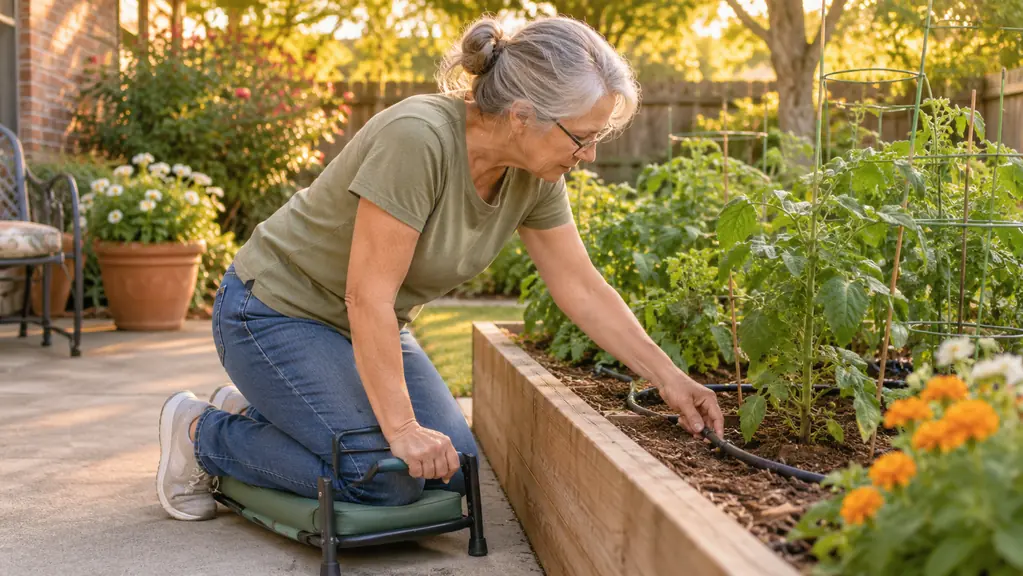
The Middle Ground Nobody Mentions
You do not have to pick. Doreen still runs her soaker hose down the long row of beans, and I have stopped trying to talk her out of it, because for that one job it is the right tool. Meanwhile the MIXC kit handles my raised bed and the peppers and tomatoes in the plot, where aim matters. If you already own a soaker hose, the honest advice is to keep using it where it works and spend your money on aim where aim is what you are missing.
The other thing worth knowing is that neither one of them feeds anything. I put Espoma Tomato-tone on the tomatoes and peppers in the plot, and a light feeding on the bush beans in the raised bed, and that is a separate job from watering. Water gets the plant what it needs to drink. It does not replace what is in the clay, and the clay here is not generous.
Who Should Buy Which
Buy the MIXC drip kit if you have a raised bed, or a plot where individual plants need individual attention, or a body that has opinions about bending over in July. Buy it if you are willing to spend one afternoon in spring and want to spend no evenings at all after that. Buy it if your water is hard enough that a soaker hose has already gone patchy on you once.
Buy the soaker hose if you have long straight rows and nothing else, if the budget is genuinely tight, if you are trying watering for the first time and are not sure you will keep at it, or if you like being out there in the evening with a hand on the soil. There is nothing wrong with that. It is not a lesser way to garden. It is a different set of tradeoffs and it costs less to find out whether you like it.
What I would not do is buy a soaker hose for a raised bed. That is the one case where I think the cheap option is the wrong option, and it is exactly the case I have two seasons of watching. If you are going to make one change to how you water, and you have a bed sitting on a patio with a spigot on the wall behind it, make it this one. If you are watering 30 feet of beans in a straight line in the back of the plot, keep what you have and spend the money on something else. Neither of these is complicated. One of them just fits your garden and one of them does not.
Two seasons, sixteen nozzles, one spigot
The MIXC kit I run on my own plot and raised bed. 100 feet, rated to 60 psi, runs off water pressure with no timer to set. Set it up once in spring and turn the spigot by hand.
Amazon Check Today's Price on Amazon →