
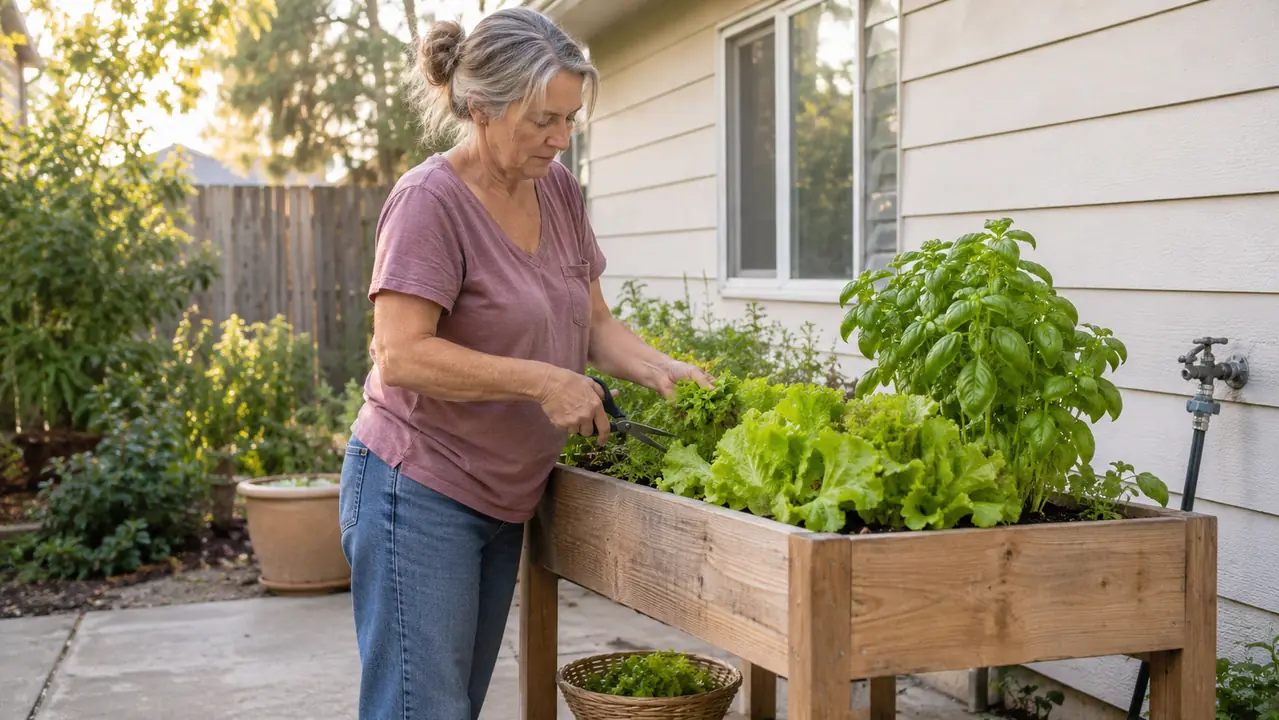
I bought the Best Choice Products raised garden bed in April 2025, and this is the version of the review I wish somebody had handed me at the register. The bed does the one job I bought it for, which is letting me tend a crop standing up. It does not do several of the jobs I assumed it would do, and the photographs on the listing are more generous about those than a 72 inch planter deserves. I still use it every week of the season, I would buy it again, and I would buy it knowing three things I did not know in April.
For context, because a review without context is just an opinion: I am 58, I retired in 2023 after years of dispatching school buses, and I live in Asheboro with my husband Roy. We have an in-ground plot, 20 by 12 feet, in that red Piedmont clay that bakes like brick by August, and I have gardened it every year since 2015. My knees are stiff and my lower back tires from bending. That is the entire reason an elevated bed made sense to me. Roy helped me lift it onto the patio once it was together and has not touched it since, which is also true of the plot.
The Quick Verdict
Two full seasons on a concrete patio. It does the job I bought it for, the planting trough is tighter and thirstier than the photographs suggest, and the unfinished fir has held up better than I expected.
Amazon Check Today's Price →The bed I still walk out to every morning of the season
72 by 24 by 30 inches, six legs, a divider panel and a drainage hole, rated to 300 pounds. Mine has had two full seasons on a patio and has not warped, sagged, or needed a single repair.
Amazon Check Today's Price on Amazon →How I Have Actually Used It
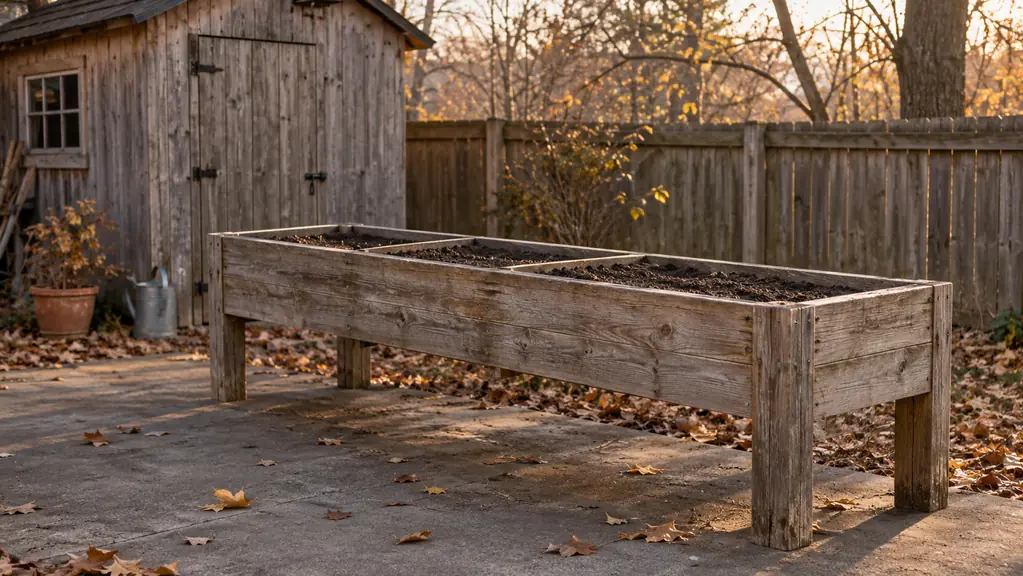
The bed sits on the south edge of our concrete patio, close enough to the kitchen door that I can be out and back before the coffee goes cold. It has stayed in that spot since the day we set it down, through two summers and two winters. It will sit there again this winter, empty of crops, because I do not try to grow anything in it past the first frost in late October. That is a point the pictures do not make. This is a piece of yard furniture for four months of the year whether you want one or not.
What grows in it: leaf lettuce, spinach, radishes, green onions, bush beans, basil and parsley. That is the whole list and it has not changed in two seasons. Tomatoes stay out in the plot with the peppers and squash and pole beans, because a tomato wants more root room than a shallow trough gives it and I am not going to argue with a tomato.
The routine is simple enough that I have never once skipped it. Every morning in summer I walk out, turn the spigot on the back wall by hand, let the drip line run about twenty five minutes, and turn it off. Six of the sixteen nozzles on that kit are on this bed. I have never added a timer and I do not intend to. Twice a week I walk the bed with my hori hori, cut what needs cutting, pull what needs pulling, and I do all of it standing up. That is the whole value for me, and after two seasons it still holds.
One morning in early July I want to describe, because it is the whole case for the bed. It was already hot at eight, the kind of morning where the air just sits on you. I went out with a colander, cut lettuce and a handful of basil, pulled four green onions, and never bent over once. My knees did not complain and my back did not complain. That same job would have been ten minutes on my hands and knees in the plot. It took about three.
What Nobody Tells You About the Planting Space
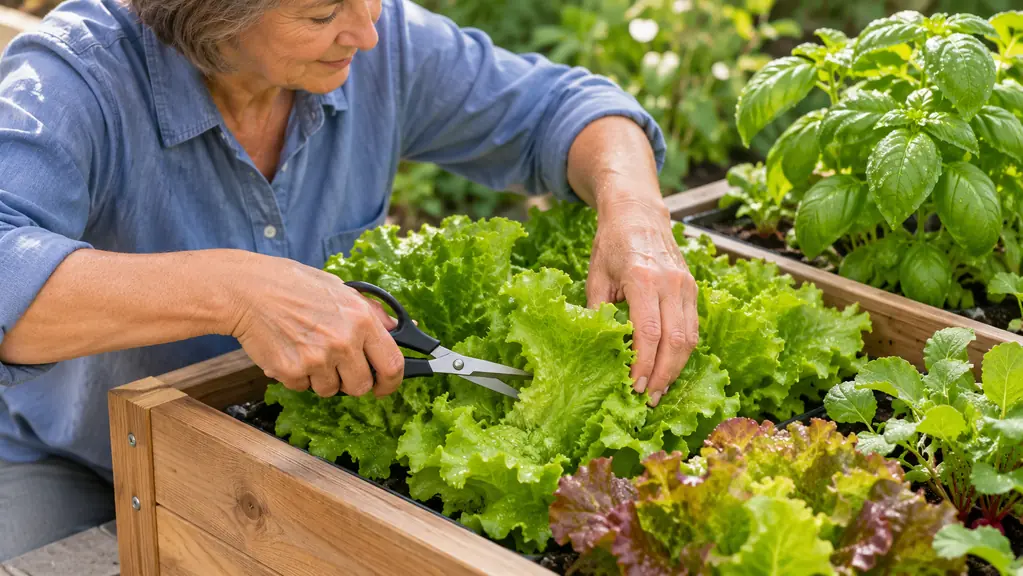
8.4 cubic feet sounds like a lot when you read it on a screen in your kitchen. It is not a lot when you are standing in front of the thing with a flat of lettuce seedlings in your hand. The trough is split by a divider panel, which is genuinely useful, because I can keep the basil on one side from swallowing the lettuce on the other. Divided also means each side gets less. I plant tighter in that bed than I would ever plant in the plot, and I thin harder, and I have stopped pretending I can get a second round of spinach in before the heat takes it.
Six 1.5 cubic foot bags of bagged raised bed mix filled mine. That is the number I would want if I were you, because I stood in the aisle guessing and I guessed wrong on the first trip. If you plan to fill yours with a wheelbarrow of your own compost and topsoil, you will come up short, and you will come up short again in July when the level drops.
How thick to plant, since the trough is small. Lettuce goes about six inches apart on each side of the divider. Basil gets one plant per section, because two will fight and one will lose. Radishes I sow in a short row and thin to two inches. Those are not numbers out of a book. They are numbers I arrived at by planting too thick the first spring and watching half of it sulk for a month.
The trough is shallow, and shallow means it dries out fast. That is the one complaint I have and it is a real one. In July, in this heat, the top of that soil is dry by mid morning whether or not it rained the night before. That is exactly why the drip line runs to it, and why I put six nozzles there instead of three. If you buy this bed and plan to keep it watered with a watering can, you will be out there twice a day in a normal Carolina summer, and you will get tired of it long before the lettuce does.
The trough is shallow, and in July it dries out fast. That is the one complaint I have, and it is the reason six of my sixteen drip nozzles run to this bed.
The Wood, and What Two Summers Did to It
The bed is unfinished Chinese fir. I left it unfinished on purpose, because I did not want to spend every other spring sanding and sealing a planter. By the second summer it had gone a soft silver gray. I like that and you may not, and if you do not, the time to deal with it is the weekend you build it, not two years later. Best Choice Products ships it unfinished and the weather does the rest, which is honest enough, but nobody says it out loud on the listing.
I did try one thing the first spring and it did not work. I wiped the outside boards down with a rag and a little linseed oil left from a porch rail, on the theory that it would hold the weather off. It went uneven within a month, patchy where the rag had been heavier, and I quit. I am not telling you not to. I am telling you what I did.
What surprised me was the sturdiness. I expected sagging by now and there is none. The boards have not pulled apart at the joints and the six legs have not racked, even on concrete, even with a full load of wet mix. Best Choice Products rates the bed to 300 pounds and after two seasons I believe the rating.
What I cannot tell you is what it looks like after five years, because I have had it for two. Anybody who tells you a fir planter is a twenty year object is guessing. I would plan on the bed having a life, and I would not buy this expecting it to outlive the house. That is not a complaint. It is an honest expectation, which is what this review is for.
The Assembly, and the One Thing I Would Do Differently
I assembled it myself on a Saturday in about two hours with a screwdriver. Not a power driver, a screwdriver. I am not handy in the way people mean when they say handy. I dispatched buses for a living. The instructions were the folded paper kind with the parts laid out, I did not have to call anybody, and I did not have to make a second trip for a missing piece.
The hardware came in a bag with the screws sorted into separate compartments, which sounds like nothing until you have built something where it is not true. I laid the boards out on the patio in the order the sheet listed them and I never had to take a piece back off. Somebody who does this for a living would have had it together in an hour.
Two honest notes. First, build it close to where it is going to live, because once it is full of soil it is not moving. I built mine on the patio and Roy and I lifted it into place before the bags of mix came off the truck. Second, the divider panel goes in during the build, not after. If there is any chance you want the divider, put it in on the first day. Taking the bed apart later to add it is a two person job and a bad afternoon.
There is a drainage hole in the bottom and I have never had standing water in it, including the summers when the rain comes all at once and the gutters cannot keep up. The bed sits on concrete rather than soil, so whatever drains out runs across the patio and off the edge. I have never had a stain that a hose would not take care of.
Where It Earns Its Keep, and Where It Does Not
Where it earns its keep is greens and herbs, close to the door, cut fresh, standing up. Radishes and green onions come up fast in that bed, and I can pull them on my way past with a cup of coffee in the other hand. Those are the things I quietly stopped growing in the plot years ago, because I stopped walking all the way out there for them.
Where it does not earn its keep is anything with ambition. Nothing that wants depth, nothing that wants to sprawl, nothing you intend to grow a great deal of. The bed did not replace my plot. I want to be plain about that, because half the pitch for an elevated bed is that you will not need the ground anymore. I still work the plot. I still kneel out there on a pad for the low beans, and I still grow the tomatoes and peppers and squash in the clay like I always have.
Feeding, since people always ask. The crops in this bed are light feeders compared to tomatoes, and the only thing in it that gets anything from me is the bush beans, which get a light feeding of Tomato-tone. Everything else gets the bagged mix, the water, and nothing more. That has been enough for two seasons. I am not going to tell you it will be enough in your soil, because I have never sent a sample to a lab and I am not about to start.
What I Liked
- I tend a crop standing up, which is the entire reason I bought it
- Two seasons on a patio and the fir has not warped or sagged
- Six legs on a 72 inch bed make it steadier than the four legged planters I looked at
- The divider panel lets basil and lettuce share one bed without a fight
- Assembled in about two hours with a screwdriver and no missing parts
Where It Falls Short
- The trough is shallow and dries out fast in July
- 8.4 cubic feet is less planting room than the photographs imply
- Unfinished fir went silver gray by the second summer
- Heavy enough that one person should not lift it once it is built
- It stands empty on the patio all winter whether you like it or not
What I Would Change, If Somebody Asked Me
Three things, and none of them would stop me buying it again. I wish the trough were deeper, because the drying out is the only real aggravation I have had with this bed. I wish there were a factory finish option, so the graying were a choice instead of a season. And I wish the divider panel came as a separate piece you could add later, because I nearly skipped mine and I would have regretted it by the first August.
What I would not change is the height. 30 inches puts the soil at a working height for me at 58 and I do not have to stoop or reach. What I would not change is the six legs, which keep it from wobbling when I lean on the edge with a pair of scissors. And what I would not change is the size. 72 inches fits along the patio edge without crowding the door, and the two of us can still get past it.
Who This Is For
If you have stiff knees, a back that tires from bending, and a hankering for salad greens within reach of the door, this is a reasonable buy and I would hand you the same one. If you have a patio, a balcony or a strip of concrete and no ground to dig, this turns that concrete into a growing space that genuinely works. And if you are the sort who will walk out with scissors and cut supper, you will use it every single day of the season.
It also suits a garden where you want one tidy element standing up rather than another bed in the ground. Doreen, two doors down, waters with a soaker hose and has never had a raised bed. She has looked at mine twice now and asked how the lettuce does in July. I told her the truth: fine, as long as the drip line is on it.
Who Should Skip It
Skip it if you want to grow tomatoes, corn, squash, or anything that needs room to sprawl. Skip it if you are not going to water it, because a shallow trough on a hot patio is unforgiving and July does not negotiate. Skip it if you want something that still looks new in year four, because unfinished fir will not, and I would rather tell you that now than have you find out on your own.
And skip it if the cost of the bed plus six bags of mix is more than you want to put into a first experiment. That is an honest thing to say and I will say it. This is not the cheap way to start gardening. It is the way to keep gardening when bending over has stopped being something you look forward to.
Two seasons in, I would buy it again, with my eyes open this time
The one I own is the 72 inch bed with six legs and a divider panel. It keeps me standing while I work, it has survived two Piedmont summers on concrete, and the only thing I still fight is how fast the trough dries out in July.
Amazon Check Today's Price on Amazon →