
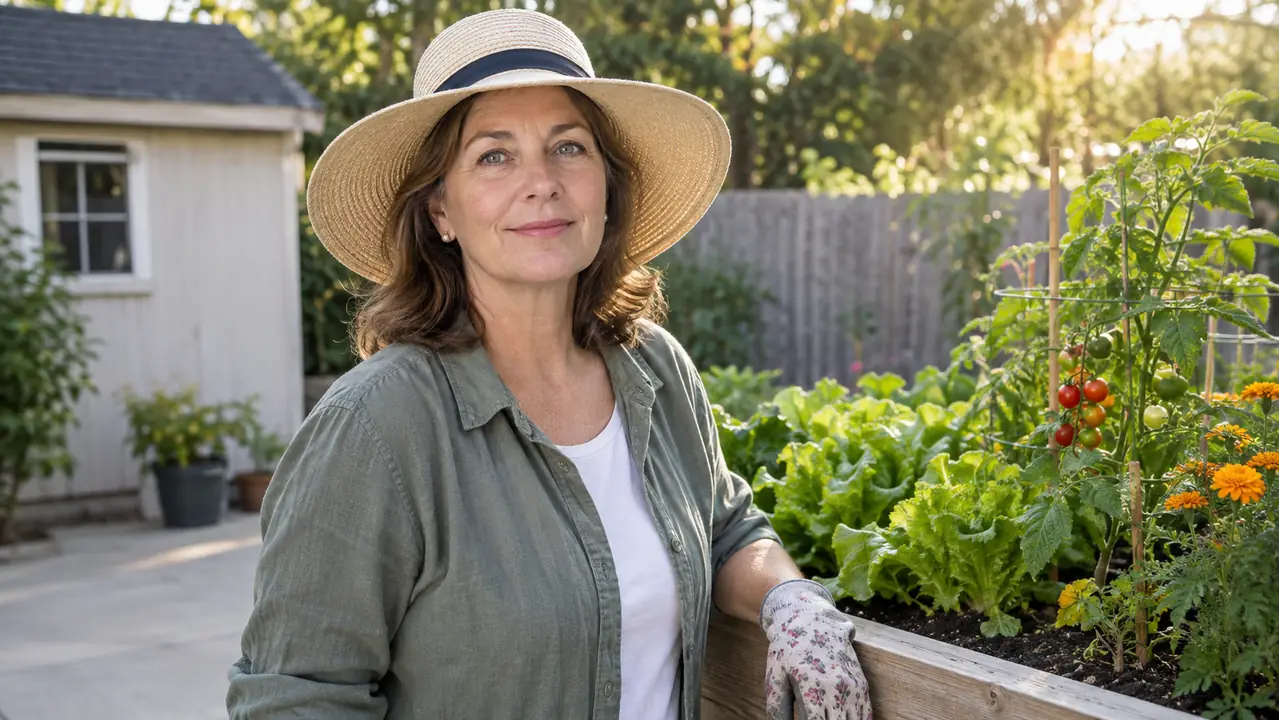
I gardened in red Piedmont clay for ten years before I ever grew a vegetable above knee height. Everything went into the 20 by 12 foot plot behind the shed, and every spring I paid for it in the lower back by the middle of July. Leaf lettuce is a low crop. So is spinach, so are radishes, so are green onions. All of them live at ground level, which means all of them live at the bottom of a bend, and by the time the heat set in I was picking them half-heartedly and letting the rest bolt.
That changed in April 2025. My husband Roy helped me lift a Best Choice Products raised bed onto the south edge of the concrete patio, and then he went back inside, because he does not garden. I had assembled it myself the Saturday before, with a screwdriver and about two hours. Two full seasons later it is sitting in the same spot, and I have not knelt down to tend a vegetable since. Not once, in two summers.
What follows is the order I actually do things in, which is not the order a garden book gives you. The box matters, but so does where you set it, what you fill it with, what you refuse to plant in it, and how the water gets there. Skip any one of those and the height stops helping you.
Stand at it, plant it, and never kneel at it again
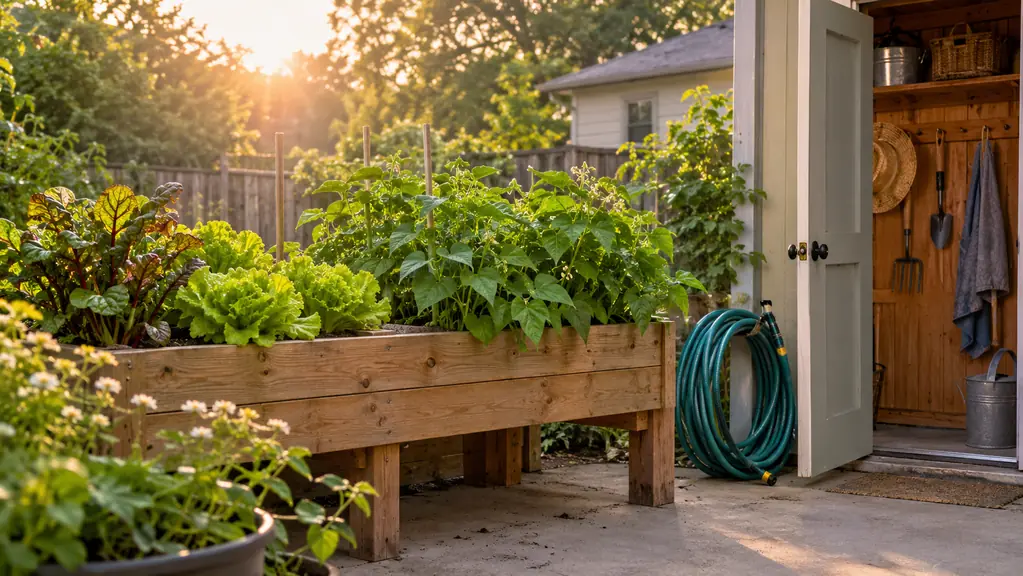
The 30 inch working height is the entire reason this bed works for me. The Best Choice Products box is 72 by 24 by 30 inches, six legs, a divider panel and drainage holes, and it holds 8.4 cubic feet of mix.
Amazon Check Today's Price on Amazon →The Five Steps, in the Order I Do Them
Step 1: Pick the spot before you pick the plants
Sun first. A vegetable bed needs light and no amount of good mix fixes a shaded corner. In March 2025 I walked the yard with a notebook for a week and watched where the light actually landed at eight in the morning and again at two in the afternoon, because those are the two hours that decide it. The south edge of the patio won. The house does not block it and the shed does not block it, and it stays that way from April through October.
Water second. My one outdoor spigot is on the back wall beside the patio, close enough that the run to the bed is short. That is not an accident of my layout, it is the reason the bed sits where it sits. A bed you have to carry a watering can to is a bed you skip on the hot days, and the hot days are the only ones that count. If your spigot is forty feet away, walk that forty feet with a full can before you commit.
Third, put it somewhere you already walk. Mine is on the patio between the back door and the shed, so I pass it four or five times a day without trying. I see a dry leaf. I see a radish that needs pulling. A bed tucked behind the garage gets checked on Saturdays and ignored in between, and in July two ignored days is enough for the bugs to get ahead of you. Proximity does more for a garden than enthusiasm ever will.
Step 2: Assemble it and set it down once
I assembled the Best Choice Products bed by myself on a Saturday in April 2025, with a screwdriver and the assembly guide that came in the box. About two hours, start to finish, and no swearing. Six legs, a divider panel down the middle, and the box itself. The whole thing weighs 37.5 pounds, which is light enough that I could tip it and walk it a few inches and heavy enough that I did not want to do that across a yard.
So I built it on the patio where it was going to live and never moved it again. Roy and I lifted it the last few feet into position on the south edge, and that was the end of his involvement. Six legs means it stands on its own without anchoring, it is rated to 300 pounds, and the drainage holes in the bottom mean water has somewhere to go besides sitting on the roots. If you build yours in the shed and then try to carry it out, you will wish you had not.
Two notes on the box itself. The fir is unfinished and I left it that way. It went gray by the second summer and I do not mind the look at all. And the bed stays out all year. In winter it sits empty of crops and I do not move it, cover it, or take it apart. Decide that now, before it is full, because once it holds mix you are not relocating it on a whim. Mine has not budged since April 2025.
Step 3: Fill it with mix, not your yard dirt
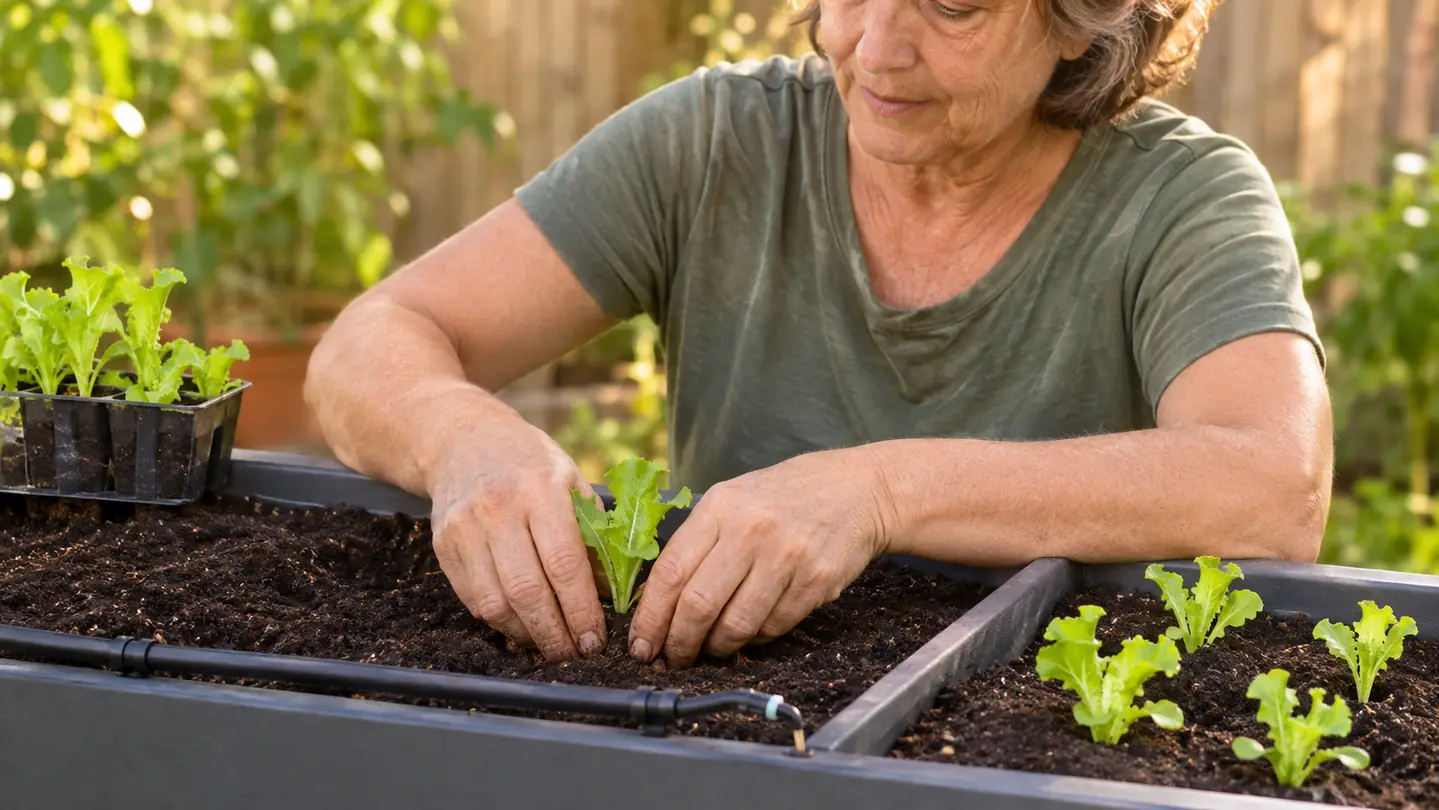
Six 1.5 cubic foot bags of bagged raised bed mix. That is what went in and that is the whole story of the fill. I did not screen clay. I did not layer gravel in the bottom. I did not build a compost bin to feed it later. I carried the bags from the truck, cut them open, and dumped them, and the whole job took less than an hour on a Saturday afternoon.
The listed capacity is 8.4 cubic feet, and there is a divider panel splitting the Best Choice Products box into two halves. That divider turned out to be more useful than I expected. Salad crops on one side, bush beans and herbs on the other, and when the lettuce bolts in the June heat I clear that half and replant it without touching the other side at all. Succession planting in a 72 inch box is easy. Succession planting in a 72 inch box with a divider is easier still.
Do not overthink this part. Bagged mix in a raised bed is fine. What I would tell you instead is that the box is shallow compared to the plot, and shallow means it dries out faster than ground does. That is not really a flaw. It is a thing you have to plan around, and it is the reason step five exists. Fill it, water it, plant it, and save the rest of your worrying for July.
Step 4: Plant what fits, not what you wish fit
The bed is 72 inches long and 24 inches wide. That is a lot of lettuce and not much tomato. I grow leaf lettuce, spinach, radishes, green onions, bush beans, basil and parsley in it. Every one of those is a small plant that does not need a trellis, does not need a cage around it, and does not need to sprawl out over the patio by August. That list is not a limitation. It is the plan.
The tomatoes stay in the plot. All six of them, Better Boy and Cherokee Purple, same as every year since 2015. People ask why I do not put one tomato in the raised bed and the answer is 24 inches. A tomato wants room, it wants a cage, and it wants to fall sideways once it is loaded. The bed cannot give it that, and I am not going to force it and then pretend I did not.
If you handed me a new bed tomorrow, here is what I would plant and in what order. Lettuce first, because it is the crop that rewards being close to the kitchen and easy to reach. Radishes next, because they come up fast and they tell you whether your mix is any good. Green onions along the front edge. Beans last, because beans fix their own nitrogen and will grow in almost anything, which makes them a waste of your good mix if you plant them first.
Step 5: Water on a schedule you will actually keep
In May 2025 I put in a drip kit. 100 feet of quarter inch tubing and 16 adjustable nozzles on bendable rods, plus the connectors. I use every foot and every nozzle: six on the raised bed and ten in the plot. It took one afternoon, about three hours, and I installed it myself with no help from Roy and no help from anybody at the hardware store.
Every morning in summer I walk out, turn the spigot on by hand, and come back about 25 minutes later and turn it off. No timer, no battery, nothing to program. The kit runs off water pressure, rated to 60 psi, and the maker suggests no more than eight rods per 50 feet of tubing, which is why mine are split the way they are. On day one a connector dripped until I pushed the tubing in further. No leaks since then.
The one real complaint I have about the bed lives right here. That shallow trough dries out fast in July, faster than the plot does. Which is exactly why the drip line runs to it and exactly why I do it every single morning instead of when I think about it. Feeding is light. Espoma Tomato-tone goes on the tomatoes and peppers in the plot. The raised bed crops only get a light feeding of it on the bush beans. The label says every two weeks through the growing season and I follow the bag.
What Else Helps
The kneeler. Mine is a TomCare, bought in March 2025 before anything was planted, and it lives folded in the shed between uses. I do not use it at the raised bed at all, because there is nothing there to kneel for. I use it in the plot, pad up to kneel and flipped over to sit on the bench when I am picking low beans and squash. The two pouches hold my twine and plant labels, and the Nisaku does not live in the pouch, it lives on my belt.
The hori hori. A Nisaku NJP650, bought in June 2025, the last of the five things I own for this garden. Stainless blade 7.25 inches long, serrated along one edge and straight along the other, inch markings on the blade, wood handle about 5.25 inches, ten ounces total, and a faux leather sheath that goes on my belt. It replaced a stamped steel trowel whose neck bent in the clay in 2024. I have run a file along the straight edge once, and that is the only maintenance it has needed.
And the thing I do not own. Doreen, two doors down, waters with a soaker hose and has for years. I have watched hers for two seasons now. It is a fine way to water a bed and I am not going to tell you otherwise. I went with rods on a line because I wanted to aim water at one specific plant instead of wetting a strip, and because I wanted one kit covering both the plot and the bed. If a soaker hose is what you already have, use it.
The old hose is still in the shed, by the way. Fifty feet, dragged around every evening from 2015 until the drip kit went in, and now it only comes out for washing things. I did not throw it away and I would not tell you to throw yours away either. Some jobs still want a hose.
The bed did not replace my garden. It moved the part of it my knees had quit doing onto the patio, where I can stand up straight and finish the job.
Two seasons in, this is the piece of it I would buy again first
The Best Choice Products bed is 72 by 24 by 30 inches, six legs, a divider panel, drainage holes, 8.4 cubic feet of mix, and enough height that the whole job happens standing up. Check today's price and the current listing before you pick your spot.
Amazon Check Today's Price on Amazon →