
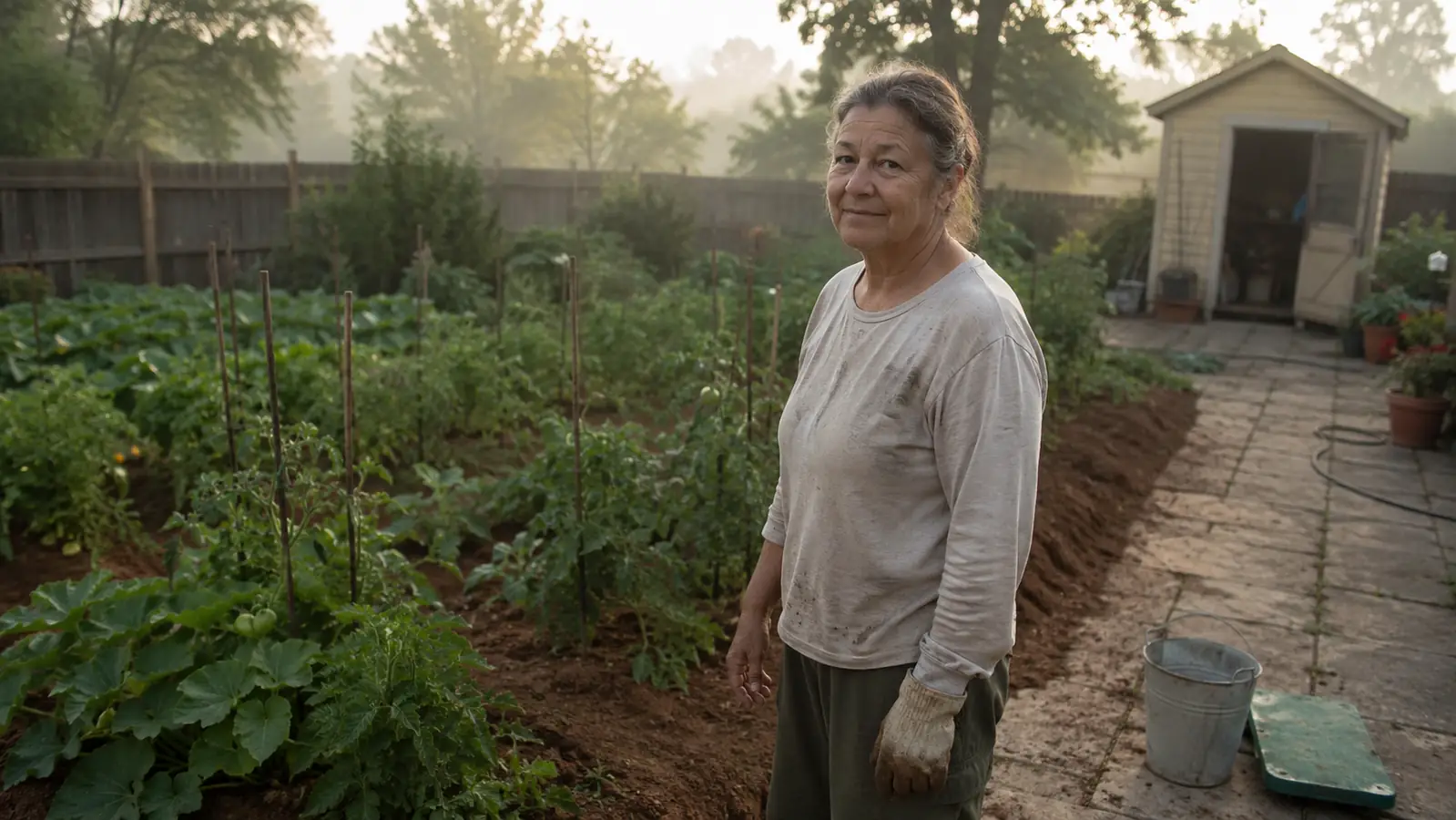
If you are standing in the aisle trying to decide between a garden trowel and a hori hori knife, here is the short answer: they are not the same tool, and neither one will do the other's job well. I have gardened the same 20 by 12 foot plot of red Piedmont clay since 2015. In June 2025 I bought a Nisaku hori hori, the last of five garden things I bought that year, and the reason I bought it was a stamped-steel trowel that folded at the neck in that clay the summer before. Two seasons on, the trowel sits in a bucket by the shed door and the Nisaku rides on my belt every time I walk out back. I am 58, retired from dispatching school buses, and I do not write about tools for a living. I just have a plot that has been in the same red dirt for eleven years and very little patience left for tools that quit on me.
None of that makes a trowel a bad tool. It makes a trowel a scoop and a hori hori a knife. Once you say it that way, the choice gets a lot simpler. A trowel moves soil. A hori hori cuts, digs, lifts, measures and opens things. If everything you grow lives in a few containers on a patio, the scoop is all you need and I would not talk you out of it. If you are digging in clay and fighting the roots that come with clay, you will want the knife. I still own both. The bent one is in the bucket because I never threw it out, and there are two or three jobs where I would still rather have a curved blade in my hand. Here is how the two compare after two full seasons of using both, side by side, in the same ground.
| Nisaku Hori Hori NJP650 | Stamped-Steel Garden Trowel | |
|---|---|---|
| Digging in clay | 7.25 inch stainless blade with no thin neck to fold over | Mine bent at the neck in 2024 and never dug straight again |
| Weeding | Serrated edge saws through runners and root mats | The point digs, but there is no cutting edge |
| Moving soil | A blade, not a bowl. Soil slides off it | Curved blade holds soil and carries it |
| Planting depth | Inch markings stamped down the blade | No markings, you eyeball the hole |
| Cutting twine, opening bags | Straight edge and serrations both handle it | Not what it is made for |
| Carrying it | Faux leather sheath, rides on a belt or hangs on a peg | Drops in a back pocket, no sheath to keep up with |
| Replacing it | Same one after two seasons of hard digging | The tool you replace without a second thought |
| Warranty | 2 year manufacturer | None I ever used |
| Best for | Clay, weeds, roots, twine, one tool out in the plot | Scooping, containers, and a tool you can hand to anyone |
Where the Nisaku Hori Hori Wins
The clay is the whole argument. A trowel's blade is rarely what fails. The neck is where they go. Mine folded in 2024 and after that the blade pointed off to one side and every hole I dug came out crooked. The Nisaku has a 7.25 inch stainless steel blade and it has not bent. I have not been gentle with it either. I have used it to lift squash vines off the ground and to work loose a stubborn clump at the edge of the plot, and nothing about it has given.
Let me tell you exactly how the trowel died, because that story is the whole comparison. It was late summer 2024 and I was setting the last of the season's pepper plants in the plot, near the end of the tomato row where I have never worked the ground as deep. There was a rock in the hole about the size of my fist. I did what anybody does. I put the point behind it and levered. The blade held fine. The neck, that narrow stretch between the blade and the handle, folded sideways like a spoon left on a hot stove. I finished that season with it because I am stubborn, and I complained about it every single time I knelt down.
One edge is serrated and one is straight, and that pairing does more work in my garden than any other hand tool I own. The straight edge goes into the soil like a trowel point. The serrated edge saws through the bermuda runners and the mats of root that come up with them, and if you have ever pulled at a runner until it snapped and left half of itself in the ground, you know why that matters. I have cut twine with it, opened bags of Espoma Tomato-tone with it, and sliced through a soft squash stem that needed to go. It is ambidextrous, which means my husband Roy could use it if he gardened. He does not, so that particular feature is wasted in this house.
The blade carries inch markings stamped down its length, and I use them more than I expected to. When I set a tomato start in the plot, the hole needs to be deep enough that the first set of leaves stays above the soil line. The markings take the guesswork out of that. Same for basil going into the raised bed. I have never weighed a harvest in my life and I am not about to start keeping numbers, but a depth is a different animal. It is right there on the blade and I can read it.
It weighs 10 ounces with a 5.25 inch wood handle. That is light enough that I forget it is on my belt and heavy enough that I can feel where it is when I reach. It ships with a faux leather sheath, which hangs on the peg rack in the shed between trips and rides on my belt out in the plot. There is a 2 year manufacturer warranty on it, though I have not had a reason to look into that.
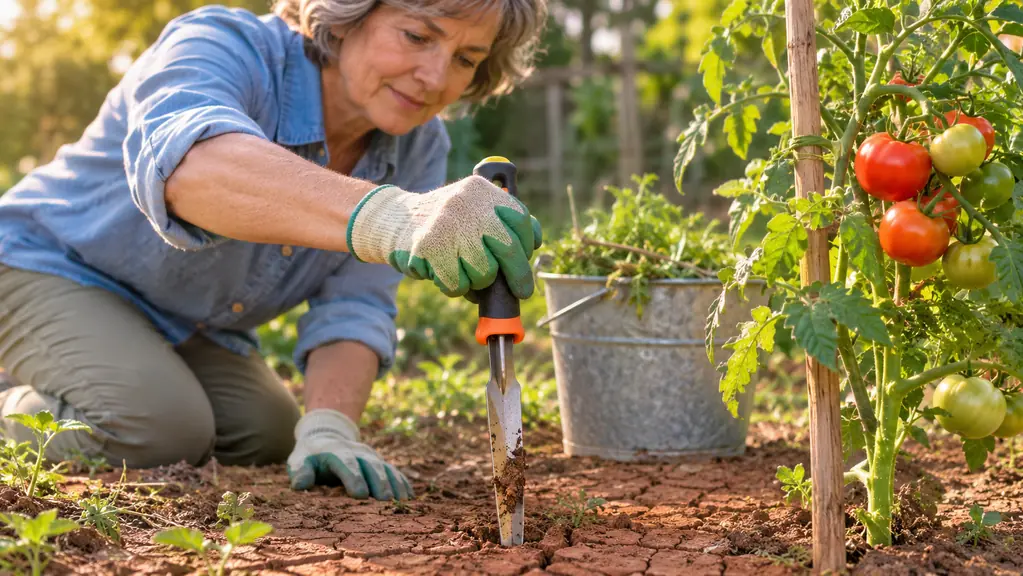
The first real morning with it was a Saturday in June 2025, and I remember it because I had a flat of Better Boy and Cherokee Purple starts sitting in the shade waiting on me. I turned the spigot on for the drip kit, twenty five minutes by habit, then walked the plot with the knife instead of the trowel. Six holes for six tomato plants. Straight down, no levering, no rock getting the better of anything. The walls of the holes stayed clean instead of smearing shut the way they do when you pry at clay with a bent tool. I had all six in the ground before the drip line finished running. That is not a fast job. It just went the way it was supposed to go for once.
Three tools left my garden after the Nisaku came home, and I did not plan any of it. The bent trowel went in the bucket. The dandelion fork went next, because the serrated edge does the same work without me kneeling down to aim it. The old kitchen knife I kept for twine went last. That was not a decision so much as a slow noticing that I kept reaching past them.
I have run a file along the straight edge once, this past spring, and that is the only upkeep it has asked for. I do not oil it, I do not sharpen it on a schedule, and I do not baby it. I rinse the clay off with the hose at the spigot, dry it on my jeans, and hang it on the peg rack. No rust, no loose handle, and I have never cut myself on it. The bent trowel, for what it is worth, is still in the bucket. I keep meaning to throw it out.
The blade never was the problem. The neck is where a trowel goes.
Where a Garden Trowel Wins
Scooping. That is the honest answer, and it is not a small thing. A trowel's blade is a bowl. It holds what you put on it and carries it where you want it to go. The Nisaku's blade is a blade and not a bowl, so soil slides off it before you get anywhere. When I set a tomato plant I make the hole with the knife and then push the soil back around the stem with both hands, and a decent trowel would do that second part faster and a lot neater than my hands do.
Filling anything is where I miss it most. When the raised bed went together in April 2025, I filled it with six 1.5 cubic foot bags of raised bed mix, and I moved every bit of that with a bucket and my hands. A trowel would have been the right tool for that afternoon, no question. Same story every spring when I top off a pot of basil or move mix out of the bag into a tray. Bagged mix is light and loose and a trowel scoops it in three passes. The Nisaku, honest to a fault, is bad at it.
A trowel is also the tool you hand to somebody else without thinking about it. Doreen two doors down has borrowed a trowel from me and I never once worried about whether it would come back. I would not hand her the Nisaku, and she would not ask for it. If a trowel walks off, you replace it and have forgotten about it by the weekend.
And if your whole garden is a few containers on a patio, a trowel is enough. I mean that plainly. A hori hori is built for ground that fights back, and potting mix in a bucket is not a fight. There is also the simple fact that a trowel has no edge to think about. You can leave it out in the rain, drop it on the concrete, and let somebody else use it badly. The Nisaku has a blade I keep an eye on, and I do not leave it out.
There is the matter of who else is going to touch it, too. Roy does not garden, but he will hold a pot steady or carry a bag of mix if I ask him, and I hand him a trowel without a second thought. I would not hand him the knife. It has an edge on it, and a tool with an edge is a tool you pay attention to. If a neighbor wanders over while I am setting lettuce in the raised bed, she gets the trowel. That ease is worth something real and I am not going to talk it down just because the knife is the better tool for me.
If the clay has already bent one trowel, stop buying trowels
The Nisaku NJP650 is 7.25 inches of stainless steel with inch markings down the blade and a serrated edge for the roots a trowel cannot cut. It comes with a sheath and weighs 10 ounces. Two seasons in red clay and it has not bent.
Amazon Check Today's Price on Amazon →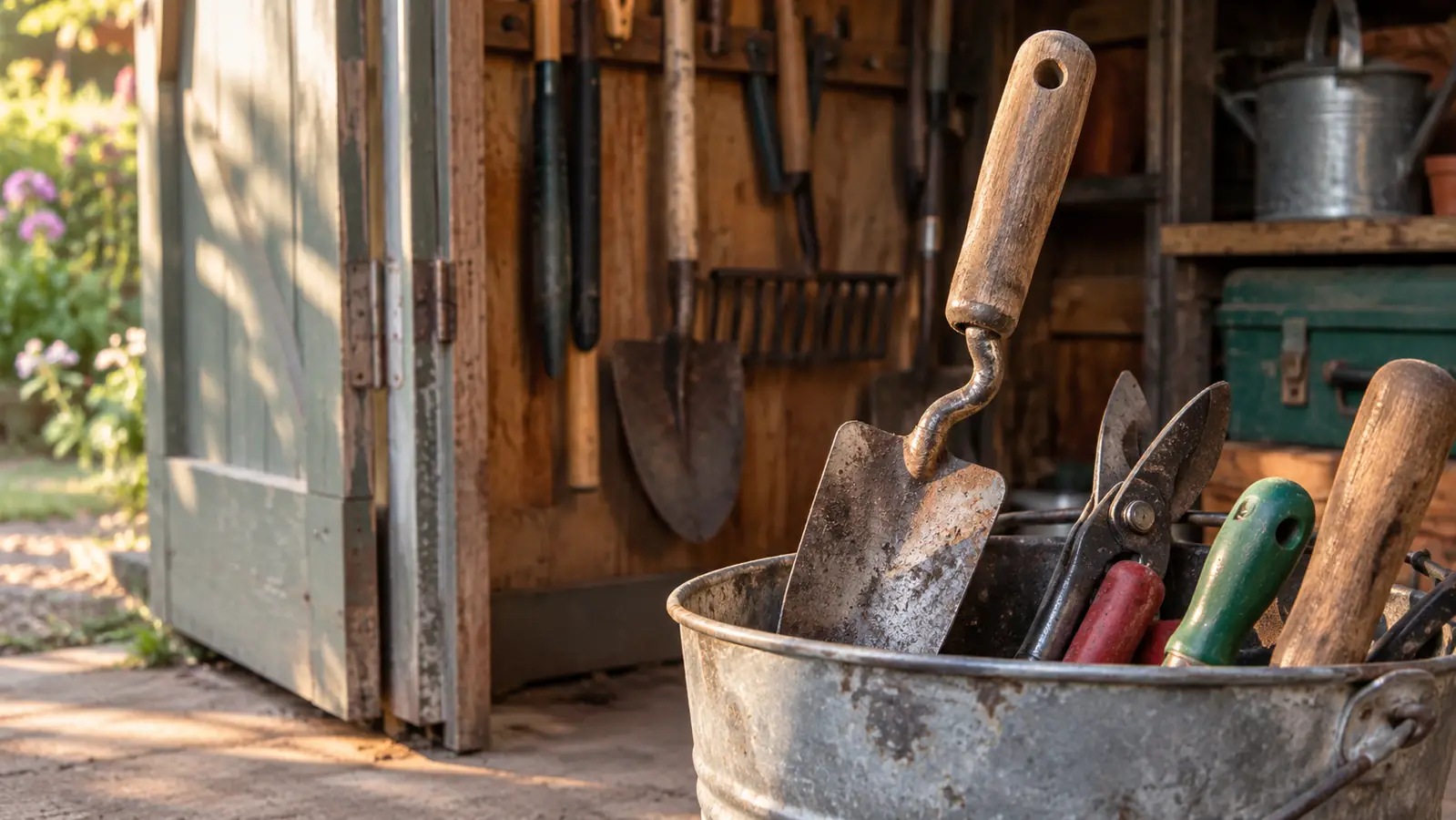
Who Should Buy Which
Buy the Nisaku first if you garden in the ground. Clay, packed dirt, a plot you have worked for years and still fight with, weeds that come back from the root, tomatoes that need a deep hole and twine that needs cutting. If you find yourself on your knees with a bent trowel trying to lever something out of the dirt, you have already answered the question. That was me in 2024, and I wish I had spent the money a season earlier instead of finishing the year with a crooked tool.
Buy the trowel, and only the trowel, if your growing happens in containers, bags and pots. A scoop is the right shape for that work and a knife is not. Buy one you do not mind losing and keep it by the back door. It will do everything you ask of it, and if it disappears into a neighbor's bucket you will not lose sleep over it.
The raised bed is the odd case and it is worth being straight about. That bed holds leaf lettuce, spinach, radishes, green onions, bush beans, basil and parsley, and it is filled with bagged mix and not clay. A trowel would be perfectly happy in there. I use the Nisaku anyway, and the reason is not the ground. The reason is that the knife is already on my belt when I walk out the door, and going back to the shed for a scoop I need twice a month is not something I am going to do. That is a habit, not a recommendation. If the raised bed were the only thing I had, I would own a trowel and nothing else and be fine.
If you can only buy one and you are not sure, walk out to your garden and look at the ground. Loose, dark, crumbly soil that you buy by the bag says trowel. Red clay that has been there since before you were born says knife. And if you end up with both, that is not a waste. Mine live four feet apart, one on a peg and one in a bucket, and only one of them still earns its place.
The one hand tool I still carry after two seasons
It hangs on the peg rack in my shed and rides on my belt in the plot. If your ground is the kind that ruins cheap tools, this is the one to start with.
Amazon Check Today's Price on Amazon →