
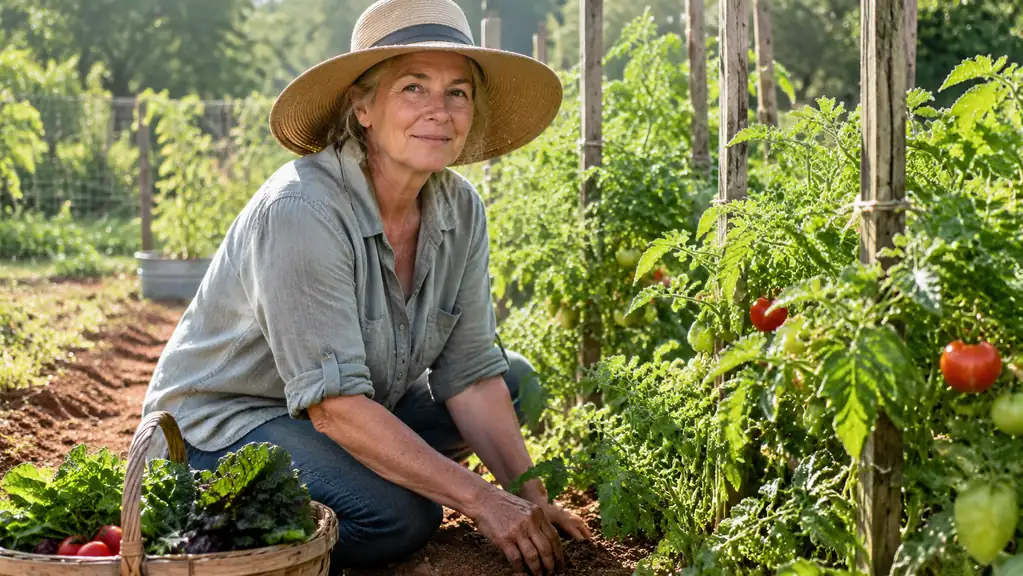
I bought a bag of Espoma Tomato-tone in late April of 2025 with a chip on my shoulder. From 2019 through 2024 I had fed my tomatoes with the blue water-soluble powder mixed in a watering can, and I did not believe a granular organic product would keep up with something that dissolves and goes straight into the soil. I bought the pack of two because it was the only size on the shelf, and I figured I would use it up on the peppers if the tomatoes did not take to it. Two full seasons later I am still using it. That is not the same as saying it changed everything overnight, and the overnight part is what most of the writing about organic plant food leaves out.
Here is the honest setup. I garden one in-ground plot, 20 by 12 feet, in red Piedmont clay, in Asheboro, North Carolina, and I have gardened it every year since 2015. Six tomato plants, Better Boy and Cherokee Purple, plus bell peppers, squash and pole beans. No soil test. No scale. No notebook. What I have is two summers of paying attention and a husband named Roy who does not garden and will tell you so.
The Quick Verdict
Slow acting, earthy smelling for about a day, and reliable on a two week schedule. It is not a rescue product for a plant that is already in trouble.
Amazon Check Today's Price →Two 4 pound bags covered two full seasons of tomatoes
A 3-4-6 granular with 8 percent calcium, approved for organic gardening, fed every two weeks through the growing season. Check today's price on the two bag pack.
Amazon Check Today's Price on Amazon →What Nobody Tells You About Organic Plant Food
The first thing nobody tells you is that organic granular feeding is a schedule, not an event. The bag says every two weeks through the growing season, and that is the whole method. There is no mixing, no measuring into a can, no waiting for a color to change. You scatter it, you work it into the top of the soil, you water it in, and then you do it again in fourteen days. If you are the kind of person who forgets things, this is harder than a liquid, because there is nothing sitting on the shelf reminding you. I tied it to my watering routine and that is the only reason I kept up with it.
The second thing nobody tells you is the smell. It is earthy and a little barnyard for about a day after you put it down, and then it is gone. I noticed it more in the humid stretch of June than in the dry weeks. If you garden close to a patio where people sit, put it down on a morning when you are going to be away from the house. Stored in a lidded bucket in the shed, it does not bother anything at all.
The third thing is that it is slow. Nobody selling you a bag of organic plant food puts the word slow on the front, because slow does not sell. I noticed a difference by about the sixth week, not the sixth day. If you are buying this to fix a tomato plant that is already yellowing and dropping blossoms, you are going to be disappointed, and you are going to blame the product. It is feed. It is not medicine.
The reason I switched at all is worth telling, because it is not a story about organics. Through 2019 I mixed the blue powder in a one gallon watering can at the spigot on the back wall, beside the patio, and carried it out to the plot. Six tomato plants and a row of peppers took two cans, sometimes three in a dry week. Mixing was never hard. Carrying was. By 2024 my right knee had gotten stiff enough that walking a full can of water across the yard twice, on uneven clay, was the part of the evening I dreaded. The powder itself worked, and I want that on the record. I stopped because of the can, not because the product failed me. Espoma Tomato-tone took the can out of the job entirely, and that is the honest reason I gave it a whole season to prove itself instead of giving up on it in June.
How I've Used It, Start to Finish
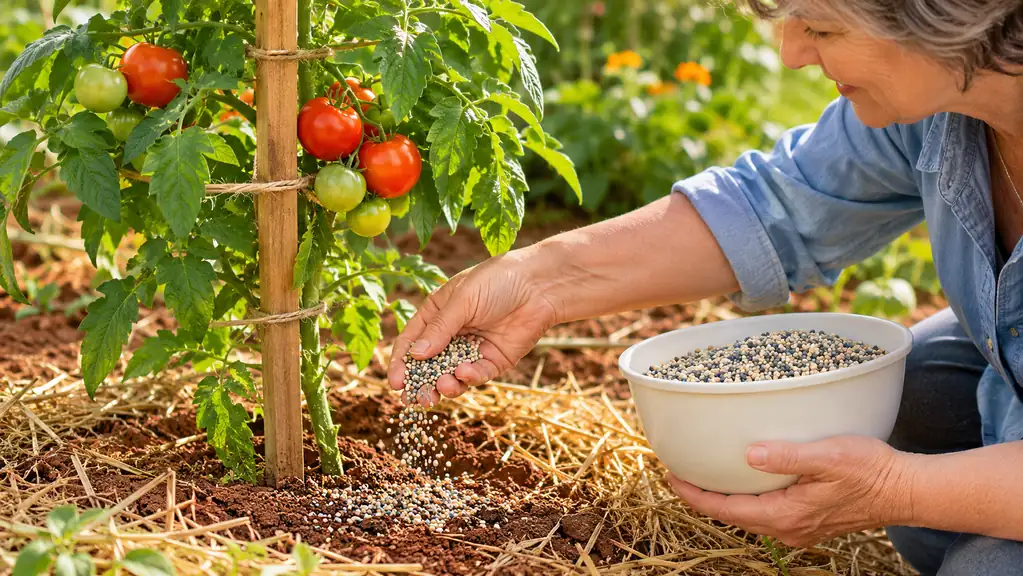
I put the first application down in late April of 2025, the same week the six plants went into the plot. I followed the bag directions exactly, and I am not going to give you a spoon measurement, because the bag has its own directions and mine would only confuse you. I scatter it in a ring around each plant, work it into the top inch or so with the hori hori, and then water it in. From there it is every two weeks through the growing season, until the plants wind down in the fall.
I can tell you the first day exactly. A Saturday in late April, overcast, and the plot still holding moisture from rain two days before, which is the only condition I will plant into with clay this heavy. I set the six plants out that morning and dug each hole with the hori hori, about twice the width of the root ball. I put a portion of Tomato-tone in the bottom of each hole and stirred it into the loose soil so the roots were not sitting directly against it, then backfilled, firmed each plant in with my knuckles, and put a ring of it on the surface around each stem, a few inches clear of the stem itself. Watered it all in slow from the hose that afternoon. Then I did not touch it again for fourteen days. That second application is the one people skip, and skipping it is the same as not buying the bag.
One 4 pound bag did my six tomato plants and the peppers for a whole season. The pack of two therefore covered 2025 and 2026, and I did not buy tomato food again until this past spring. I keep the open bag in a lidded bucket in the shed so it does not take on moisture, and I keep the scoop in the bucket. The measuring is not fussy, which is the one place I will give it real credit over the blue powder.
The raised bed on the patio does not get it, for the most part. That bed grows lettuce, spinach, radishes, green onions, bush beans, basil and parsley, and the only thing in it that sees Tomato-tone is the bush beans, and they get a light feeding, not the full rate. Tomatoes have never grown in that bed and never will. The bed is 72 by 24 by 30 inches and there is not room in it for a tomato plant to do what a tomato plant wants to do.
The Slow Part Is the Whole Point
By about the sixth week of that first summer I noticed two things, and I want to be careful how I say them, because I did not run a trial and I did not keep a control group. The first was that the plants looked steadier. Not bigger. Steadier. The leaves held their color through the hot stretch in July instead of going pale and tired the way they had in past years. The second was that I was picking fewer tomatoes with the dark rotted bottom on them.
July of 2025 is where I did my real looking. Asheboro in July is hot and humid, and my plot gets sun from about nine in the morning until five in the afternoon, which is hard on any tomato. In earlier years I would walk out in the third week of July and find the lower leaves on the Better Boys going yellow and papery, and I would strip them off and tell myself that was normal. In 2025 the yellowing started lower and it started slower. It still started. I am not going to pretend it did not. What changed is that it did not run up the plant the way it used to, and by the time the Cherokee Purples were setting their second round of fruit in early August, the Better Boys still had good green leaves down to about a foot off the ground. The Cherokee Purples were always the fussier of the two, and they stayed fussier all season. Nothing in a bag of plant food makes a Cherokee Purple easy.
What I will say is that this product carries 8 percent calcium on the label, and 8 percent calcium is not something the blue powder I used before advertised, and the timing of fewer dark bottoms lined up with the switch. That is what I saw. It is not proof. It could have been the rain that year. It could have been that I was watering more evenly, since the drip kit went in the same month. I have now had two summers of the same result, which is enough for me to keep buying it and not enough for me to tell you it will do the same in your garden.
One 4 pound bag per season. The pack of two covered 2025 and 2026. I have not gone back to the blue powder. That is the whole endorsement.
The Calcium Question
Every spring somebody at the feed store tells a customer that calcium stops blossom end rot, and every spring somebody's tomatoes get dark bottoms anyway, because uneven watering does more damage in most gardens than low calcium does. I am not qualified to settle that argument and I am not going to try. What I will tell you is that I did not buy Espoma Tomato-tone for the calcium number. I bought it because I wanted to stop mixing powder in a can, and the calcium is on the label whether I care about it or not.
If you have had dark bottoms on your tomatoes for years, the first thing I would check is whether your watering is even, not what is in your fertilizer. My own watering only got even in May of 2025, when the drip line went in for both the plot and the raised bed, and that is the same month I started with this product. Which is exactly why I am cautious about crediting either one of them.
What I Liked
- Fed on a two week schedule, one 4 pound bag covered a full season of six tomato plants and the peppers
- The pack of two covered 2025 and 2026, so there was no mid-season trip to town for more
- No mixing and no measuring into a watering can, which is the reason I switched
- Carries 3-4-6 with 8 percent calcium on the label, and it is approved for organic gardening
- Stores clean in a lidded bucket in the shed between applications, through two winters now
Where It Falls Short
- Slow. I did not see a difference until about the sixth week, and four weeks would not have shown me anything
- Earthy, barnyard smell for about a day after each application
- It is granular, so it goes on the soil by hand and does not travel through a drip line
- It will not rescue a plant that is already failing for another reason
- The bag directions are the only dosing guidance, and guessing at a heavier rate is easy to do
What It Does Not Do
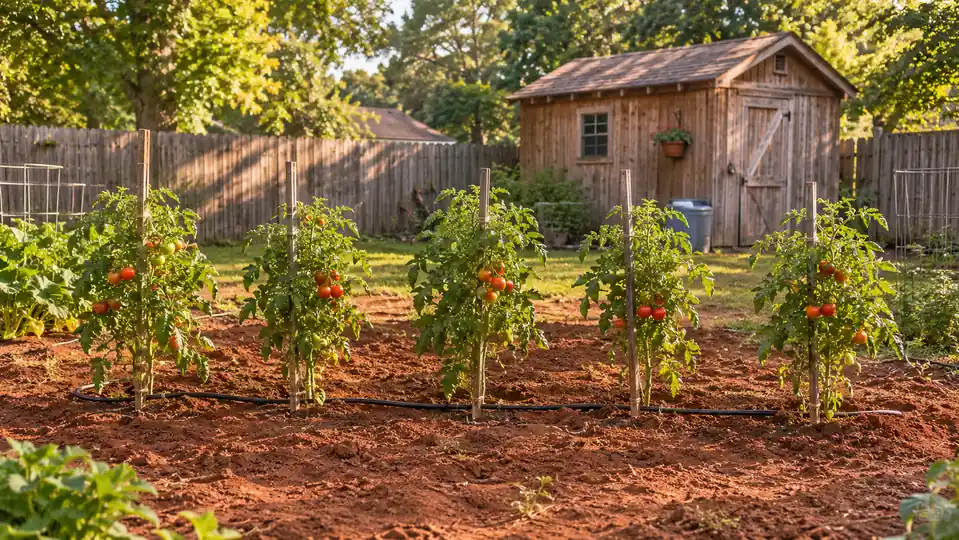
It does not fix clay. My plot is red Piedmont clay and it is still red Piedmont clay. It does not water anything, which is why the drip kit runs to both the plot and the raised bed every morning for about 25 minutes in summer. It does not replace the hori hori, or the kneeler, or any of the other things that actually make the work possible at 58 with a sore right knee and a back that tires. It is one input out of several, and it is the least dramatic of them.
It also does not travel through a drip line, and I want to be plain about that because I have seen people ask. Granular plant food goes on the soil by hand and gets watered in afterward. If you were hoping to drop something in a reservoir and forget it until August, this is the wrong product for you, and no number of good reviews is going to change that.
Two Seasons In: What Held Up
Two seasons is not a long time, and I am not going to write this like I have run a ten year study. What held up is the schedule. It is easy to keep, it is easy to remember, and it does not require me to be precise. What also held up is the storage. The open bag sat in that bucket in the shed through two winters, including the humid ones, and it did not cake into a brick the way I expected it to.
The second bag is what really settled it for me, because the 2026 season started from a different place. I opened that bag in April of 2026 out of the same bucket, and it was still loose and pourable after a winter in the shed, which surprised me more than it should have. I ran the same schedule, first application at planting and then every two weeks, straight through the summer. Here is what I noticed in 2026 that I did not notice in 2025. The plants came out of the gate slower in the spring, which I now think is normal for this feed and not a fault, and then they held on longer into September than my plants had in years past. The last of the Better Boys came off in the second week of September, and I was still picking Cherokee Purples into the first week of October, right up against first frost. I did not weigh any of it. I am giving you the dates because the dates are what I have.
What did not hold up is my patience in the first June. I wanted to see something by the second week and I did not, and I nearly wrote the whole thing off. If you are the type to give a product four weeks and then quit, save your money. Espoma Tomato-tone asks for six weeks and a calendar, and it does not apologize for that.
Who This Is For
This is for a gardener with a set number of plants and a regularly scheduled watering routine, who wants to stop mixing powder in a can and does not mind putting something down every two weeks. It suits a plot like mine, six tomatoes and some peppers, where one bag covers a season and the second bag covers the next one. It also suits anyone who wants an organic option from Espoma that is approved for organic gardening and does not require learning a whole new system.
Who Should Skip It
Skip it if your plants are already sick and you are looking for a cure, because it is not one. Skip it if you know in your heart you will not keep to a two week schedule, because a granular feed applied once in June and never again is mostly a waste of a bag. Skip it if you are gardening in containers on a balcony and need something that goes through a watering can, since this is a soil application. And skip it if you already have a feeding routine that works. There is no prize for switching.
If you are going to feed on a schedule, this is the bag I keep in the shed
3-4-6 with 8 percent calcium, 4 pound bags in a pack of two, and a two week schedule printed on the label. Check today's price and give it six weeks before you judge it.
Amazon Check Today's Price on Amazon →