
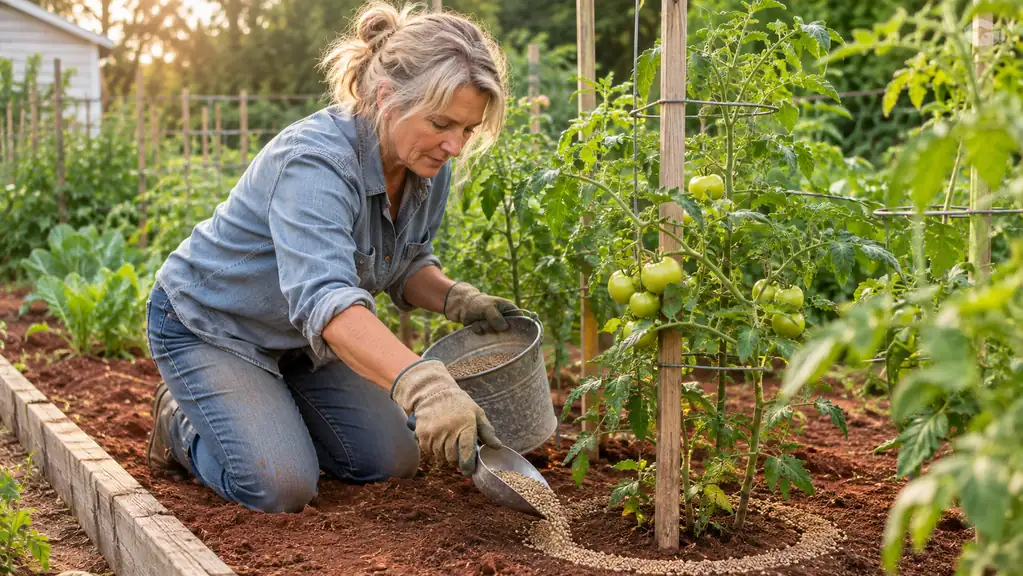
Five seasons I fed my tomatoes out of a watering can. A scoop of water-soluble powder, warm water from the spigot on the back wall by the patio, stir it until it quit clouding up, then pour a ring around the base of each plant. It worked. The plants grew and the tomatoes came. Then in late April 2025 I carried a bag of Espoma Tomato-tone down to the plot instead, worked the powder into the soil around six plants, and I have not mixed a can since. That does not make the water-soluble feed a bad product. It makes the two of them good at different jobs, and which one you want depends on how you garden and how fast you need an answer.
Short answer: Espoma Tomato-tone is the better feed for tomatoes in the ground over a whole season, because it carries 8 percent calcium and it feeds on a two-week schedule instead of after every watering. The blue water-soluble powder mixed in a can is the better feed for a plant that is in trouble this week and cannot wait six weeks for a dry powder to break down in clay. I feed my plot with Tomato-tone. If a plant stalled in July, I would still mix a can and I would not apologize for it. Anyone who tells you one of these is right for every situation has never had a Better Boy go pale on them in the middle of a hot stretch.
| Espoma Tomato-tone | Water-soluble feed | |
|---|---|---|
| Nutrient release | Dry powder worked into the soil, feeds over weeks | Dissolves in water and is available to the roots right away |
| Calcium | 8 percent calcium listed on the bag | Not something I ever looked to it for |
| How often you handle it | One application every two weeks, per the bag | Mix a fresh can every time you feed |
| Organic gardening | Approved for organic gardening, registered organic input material | Not an organic input |
| Seeing a response | Slow. I noticed by about the sixth week | Days, not weeks |
| Smell | Earthy and a little barnyard for about a day after each feeding | No smell worth mentioning |
| Correcting a plant mid-season | You can top-dress, but it still has to break down | You can mix a stronger or weaker can the same afternoon |
| Storage between feedings | Lidded bucket in the shed, stays dry and usable | A jug and a scoop, nothing to keep dry |
| Best for | Tomatoes and peppers in the ground, fed on a calendar | One plant that needs help now |
Where Espoma Tomato-tone Wins
The calcium is the reason I switched and the reason I stayed. The bag lists 8 percent calcium, and my tomatoes grow in red Piedmont clay that has been worked every year since 2015 without a soil test to its name. Starting with the first summer on Tomato-tone, I picked fewer tomatoes with those dark, leathery bottoms. I am not going to dress that up as proof. I did not run two plots side by side, I did not weigh a thing, and I have never sent a sample off to a lab. What I can tell you is that it was the one thing I changed between 2024 and 2025, and those dark bottoms stopped being a regular part of picking. If you have been slinging those over the fence every July, that is worth something to you.
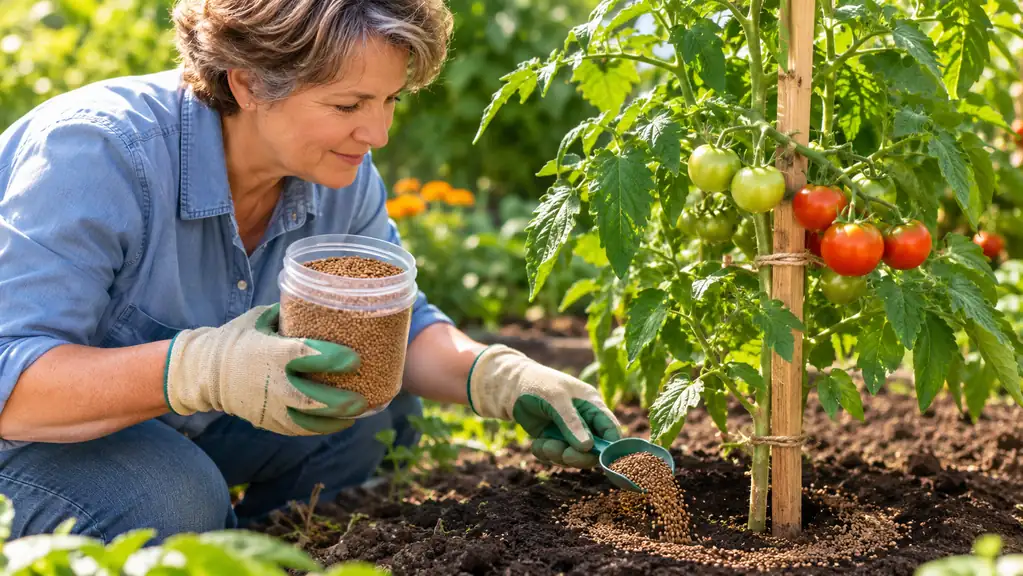
The schedule is the other half of it. The bag says every two weeks through the growing season, so that is what I do. Every other Saturday morning I take the bucket out of the shed, scoop, work it into the top of the soil around each plant with my hands, turn the spigot on and let the drip line run its 25 minutes, then put the bucket back on the shelf. It takes less time than mixing a can ever did, and it does not have to happen after every watering. The plant gets fed whether or not I am paying attention that week. Slow is the tradeoff, and I will get to that, but slow is also why I am not out there chasing a plant that surged too fast and then quit on me.
One more thing that does not show up on a bag: I am 58 with two sore knees and a back that tires from bending, and a dry powder is simply less work on a bad day. Mixing a can meant carrying a full watering can down the slope to the plot and standing there pouring six times. Now I carry a light bucket, kneel on the pad a few minutes at each plant, and I am done. That is not a gardening argument. It is the honest reason a lot of people my age quit feeding their tomatoes somewhere around July, and it is the reason I did not.
Where the Water-Soluble Feed Wins
Speed. There is no polite way to say it. A water-soluble feed mixed in a can is already in a form the roots can take up, and a dry powder worked into clay has to break down first. In 2023 I had a Better Boy go pale and stall in early July, not sick, just sitting there with its leaves turned a tired yellow-green. One can had it looking better inside a week. I have never gotten that from Tomato-tone. When I started on it in late April 2025, I could not point to anything until about the sixth week. If your plant is in trouble right now, slow food is not the answer, and no amount of loyalty to a bag changes that.
You also get to decide the strength. A can is a ratio you mix, so you can go weak on a young plant and stronger on a heavy one, and you can change your mind the same afternoon. Tomato-tone goes on the same way every two weeks whether the plant is surging or sitting still, because the bag says every two weeks and I am not smarter than the bag. And the water-soluble feed has no smell. Tomato-tone smells earthy and a little barnyard for about a day after each feeding. It does not bother me, and Roy has never once complained about it from the patio. It might bother you if you garden in a shirt you also wear to town.
Feed the plot on a calendar and quit thinking about it
Tomato-tone is a dry 3-4-6 with 8 percent calcium, applied every two weeks through the season. One 4 pound bag covered my six tomato plants and the peppers for a whole year.
Amazon Check Today's Price on Amazon →What Two Seasons in the Plot Looked Like
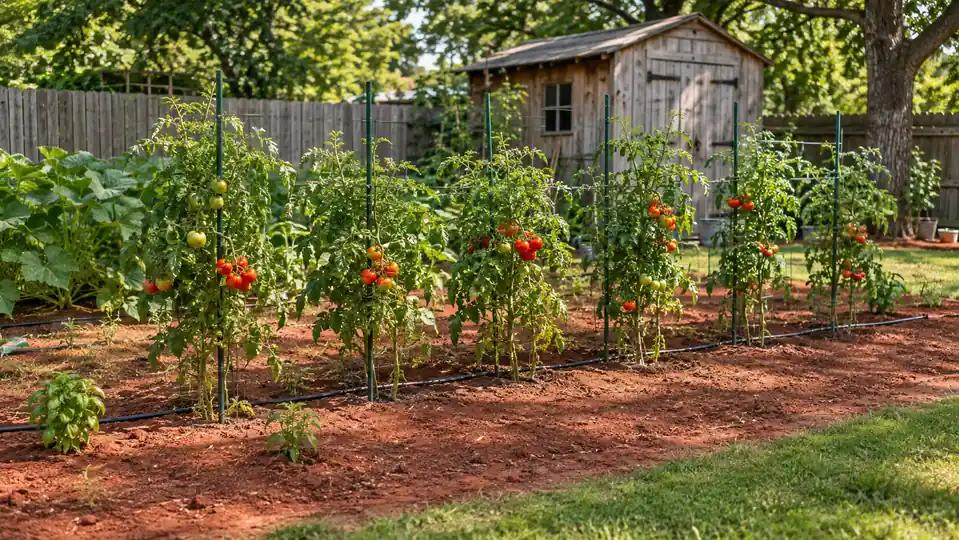
The plot is 20 by 12 feet and it holds six tomato plants, Better Boy and Cherokee Purple, plus bell peppers, squash and pole beans. I set the tomatoes in late April 2025 and worked Tomato-tone into the soil at planting, then every two weeks from there until the plants played out in October. Watering is a drip kit, six nozzles on the raised bed and ten in the plot, and I turn the spigot on by hand for about 25 minutes each morning in summer. Nothing else about the plot changed that year. Same stakes, same spacing, same clay, same me.
What I saw was not dramatic and I want to be honest about that, because dramatic is what sells. The plants did not jump out of the ground. They held on. They kept setting fruit through the sticky part of August when the heat usually makes them quit, and the foliage stayed a decent green without me pouring anything on it. The difference I could actually put my finger on was the picking bowl. Fewer of those tomatoes with the dark rotted bottoms went into it. That is the whole report, and if it sounds small to you, you have not spent a July watching a plant you like give up.
The pack of two bags made it easy to run it back. 2026 was the second bag, same schedule, same six plants, and by then I had stopped comparing it to anything. It was just what I did every other Saturday morning with a bucket and a scoop. The peppers got it too. In the raised bed, the only thing that gets a light feeding of it is the bush beans, because that bed is mostly lettuce, spinach, radishes, green onions, basil and parsley and those do not need much of anything from me. Tomatoes never go in that bed. They go in the plot, where they have gone since 2015.
The third Saturday in August 2026 is the morning I remember, because nothing happened. I filled the bucket in the shed with the hori hori on my belt, opened the bag with it, worked a ring of powder around each of the six plants, set the spigot and went back to the patio for 25 minutes while the drip line ran. Then I flipped the kneeler over and sat on the bench to pick the low squash. It took me under an hour including the sitting. Five years earlier that same job meant mixing six cans and hauling water down a slope in the worst heat of the year. That is what changed. Not the harvest. The morning.
By about the sixth week I was picking fewer tomatoes with dark rotted bottoms. That is what I saw in one plot. It is not a lab result and I will not pretend it is.
What the Bag Actually Says
Tomato-tone is a 3-4-6 organic granular plant food with 8 percent calcium, and it comes as a dry powder in 4 pound bags, sold as a pack of two. The label says it is for all types of tomatoes, heirloom and hybrid, and the blend includes what the company calls its Bio-tone formula. It is approved for organic gardening and registered as an organic input material, which matters to some people and means nothing to others. I bought it because of the calcium number and because Doreen two doors down had been on about organic fertilizer for years and I finally got tired of hearing it.
The directions say every two weeks through the growing season, and that is the number I follow. I do not measure out tablespoons or cups and I am not going to hand you a dose I made up. Scoop, work it into the top of the soil, water it in. Between feedings the open bag lives inside a lidded bucket in the shed so it stays dry, and the second bag sat there a full year, through a winter and a wet spring, and went on the plot the next April just as loose as the day I bought it. There is nothing to mix, nothing to measure and nothing stored in liquid form.
The honest limit is that a dry powder in clay is on the soil, not in it, until water moves it and time breaks it down. That is why the two-week schedule matters more than the exact dose. Missing a Saturday by a few days has never cost me anything I could see. What costs you is quitting in July because the plants look fine and you get busy, and then wondering in September why they played out early. Fed on a calendar, this bag is easy to keep up with. Forgotten in a shed, it does nothing at all.
What I Liked
- Feeds on a two-week schedule instead of after every watering
- 8 percent calcium listed right on the bag
- One 4 pound bag covered six tomato plants and the peppers for a season
- Approved for organic gardening
- Stores dry in a lidded bucket from one year to the next
Where It Falls Short
- Slow. You will not see anything for weeks
- Smells earthy and a little barnyard for about a day
- No way to give a struggling plant a fast jolt
- A plant that stalls in July waits for the next scheduled round
Who Should Buy Which
Buy Espoma Tomato-tone if your tomatoes and peppers are in the ground, if you would rather feed on a calendar than react to every yellow leaf, and if calcium and organic approval are the things you came for. It suits a garden you walk past every day but do not hover over. It also suits a body that does not want to haul a full watering can around six plants in July heat, which is most of why I stayed with it. One 4 pound bag a season is a rhythm I can keep up with at 58 with two sore knees, and a rhythm you can keep up with is worth more than a better product you abandon in July.
Buy the water-soluble feed if you are feeding a few plants in pots on a patio, if you like adjusting strength plant by plant, or if you want to see something happen this week. It is also the one I would grab for a plant that has gone pale and stalled, because it works now and the powder does not. I still own the can. I have not mixed it since the end of 2024, but it is in the shed and it is not going anywhere, and I would not tell a neighbor to throw hers out. Nobody has to pick a side here. The honest split is that one feeds a season and the other answers a question.
And if you are the kind of gardener who wants a number and a date on everything, neither bag will give you that. I have never weighed a harvest or kept a record, and I am not about to start at this point. What I can tell you is what I noticed, in one plot, in red clay, over two seasons, with six plants and a drip line I turn on by hand every morning. That is the whole of my evidence, and I would rather hand you that honestly than sell you a chart.
One bag a year, every two weeks, and the watering can stayed in the shed
If your tomatoes live in the ground and you would rather feed them on a schedule than rescue them, this is the bag I have used for two seasons on six plants in red clay.
Amazon See Today's Price on Amazon →