
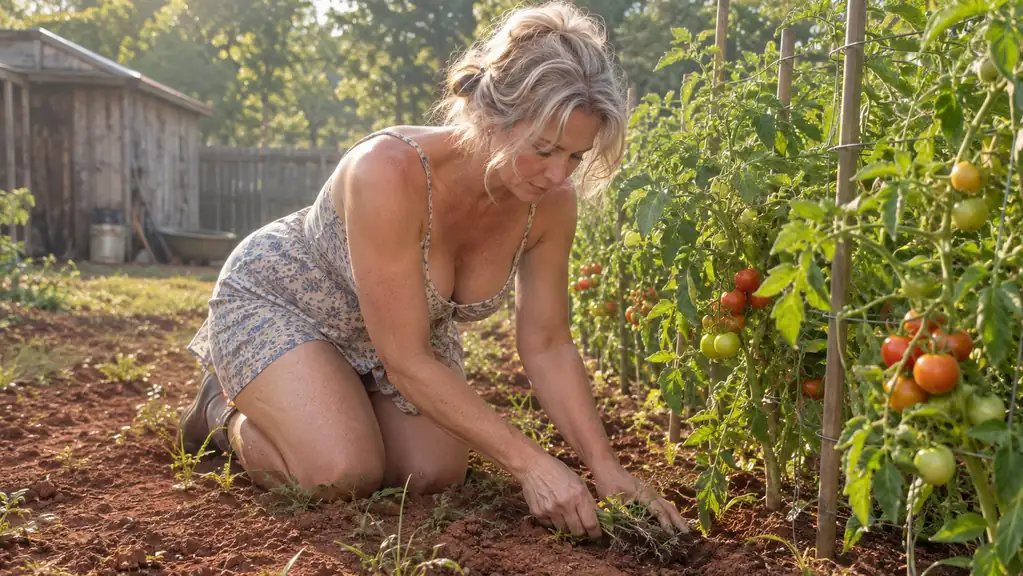
Every August for years I pulled a tomato off the vine, turned it over, and found the bottom half black and leathery. Not every tomato. Enough of them. I would stand there in the clay with a bucket in one hand, snap the bad ones off, and tell myself next year would be different. It never was, because I kept doing the same thing. I mixed water-soluble plant food in a watering can and poured it on whenever the plants looked tired, which is not a schedule, no matter how kindly you phrase it.
I am not a master gardener. I am 58, I retired in 2023 from dispatching school buses, and I have worked the same 20 by 12 foot plot in red Piedmont clay since 2015. In late April 2025 I bought a two-pack of Espoma Tomato-tone, mostly because the label said every two weeks and I wanted a rule to follow. By about the sixth week of that first summer I was picking fruit with clean bottoms. Two full seasons later I am still using it. This is what I actually noticed, including the parts I did not care for, and I will tell you up front that one other change happened the same spring, so I cannot hand Espoma all the credit.
The Quick Verdict
Slow acting and smelly for a day, but two seasons of steadier plants and fewer dark-bottomed tomatoes make it the easiest part of my garden routine. Not a rescue for a plant already in trouble.
Amazon Check Today's Price →Two bags covered two full seasons in my six-plant plot
One 4 pound bag per season, follow the every-two-weeks direction on the label, and stop mixing anything in a watering can. The two-pack is what I bought in late April 2025 and I am still working through it.
Amazon Check Today's Price on Amazon →How I've Used It
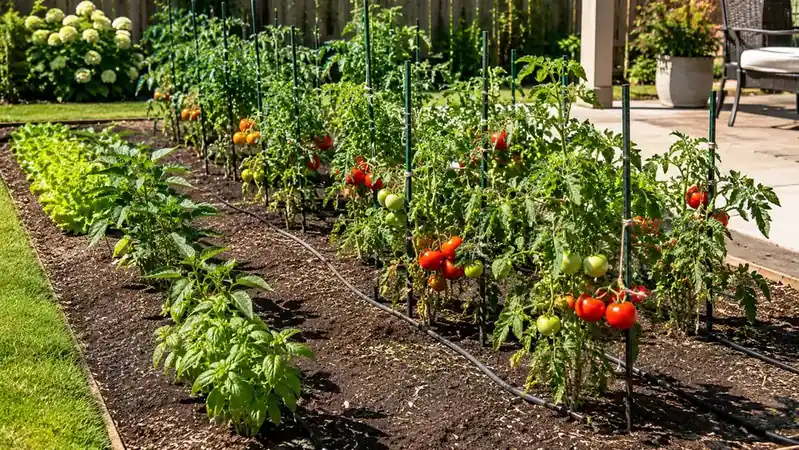
My in-ground plot runs 20 by 12 feet and holds six tomato plants, three Better Boy and three Cherokee Purple, plus bell peppers, squash and pole beans. That is the only place tomatoes grow here. The raised bed on the patio edge is for lettuce, spinach, radishes, green onions, basil and parsley, and tomatoes have never been in it. So when I talk about this product, I am talking about six plants in clay, not a patio container, not a greenhouse, and not a farm.
From 2019 through the end of 2024 I used the blue water-soluble granules, mixed in a two gallon watering can, and I mixed them by eye. That is the honest version. The little scoop was lost years ago. I would pour until the water looked about right, which means one week the plants got a strong drink and the next week a weak one, and neither of us knew which. I stopped at the end of 2024, not because anything went wrong, but because I was tired of guessing and tired of hauling that can. The can is still in the shed. I use it for washing off the patio now.
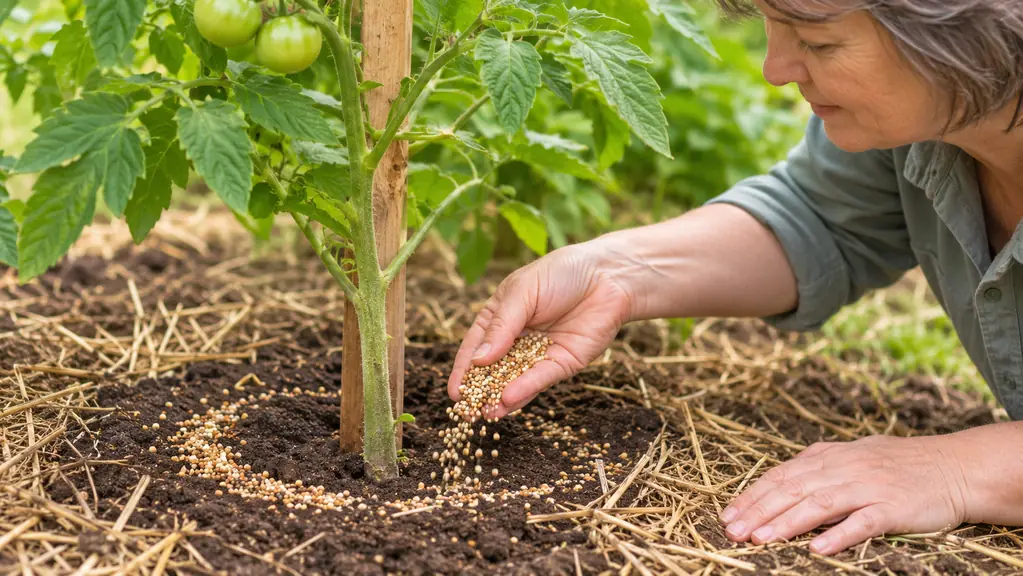
I bought Espoma Tomato-tone in late April 2025, the same week the plants went in. The label says every two weeks through the growing season and that is exactly what I do. I am not going to sit here and give you a measurement in cups, because the bag already prints one and I am not qualified to improve on it. I keep the bag in a lidded bucket in the shed, I scoop, I sprinkle it in a ring around each plant, I work it into the top of the soil with my hands, and I water it in. That last part matters. Dry plant food sitting on top of dry clay does nothing for anybody.
One 4 pound bag lasted me a whole season across those six plants and the peppers. The two-pack took me through 2025 and 2026 both, and there is still some left in the bucket. The raised bed gets almost none of it. The only thing out there that sees any is the bush beans, and they get a light pass, not a full ring, because beans do not need much and I would rather underfeed than overdo it.
What the 3-4-6 and the 8 Percent Calcium Actually Mean
The label reads 3-4-6. That is nitrogen, phosphorus and potassium, in that order, and the numbers are percentages by weight. It also lists 8 percent calcium, which is the number that got my attention, because the dark leathery bottoms on my tomatoes are the thing garden writing always ties to calcium. It is a blend of natural and organic ingredients with the company's Bio-tone added, and the bag says it is approved for organic gardening as a registered Organic Input Material. I am quoting the bag. I have never sent a soil sample to a lab and I am not going to pretend otherwise.
Here is the honest part. Calcium in a bag does not guarantee anything, because a plant can sit in calcium and still fail to take it up if the watering is uneven. I know that. I also know what I changed in the same spring, which is that in May 2025 I put in a drip kit and stopped dragging a hose around every evening. So the even watering and the plant food arrived within about three weeks of each other, and any fair reading of my two seasons has to hold both of them responsible.
What I can tell you is that the food itself behaves the way the label implies. It is slow. There is no green-up in three days like you get from the water-soluble stuff mixed in a can. It has to sit in warm soil and break down, and in cool late April soil it does close to nothing for a while.
It has to sit in warm soil and break down, and in cool late April soil it does close to nothing for a while. By the sixth week I stopped doubting it.
The First Summer, and the Six Weeks I Almost Wrote It Off
I want to be straight with you about May 2025, because a review that skips this is not a review. I fed them at planting, I fed them two weeks later, and nothing happened that I could see. The plants sat there looking exactly like plants. My husband Roy asked me twice whether the new stuff was doing anything and I told him both times that I had no idea. If I had paid for one season instead of a two-pack I might have quit and gone back to the watering can out of pure impatience.
By the second week of June I had fed them four times and made a pencil check on the shed calendar each time so I would not double up and would not skip. The fourth check fell around June 10. That is about when the Cherokee Purples started setting in clusters instead of one here and one there. I remember standing at the end of the row with the hoe, looking at them and thinking they seemed settled. That is a strange word for a tomato plant, but they had a flat, contented look to them instead of the stretched-out look they get when they are hungry and reaching for something.
Then June came, the soil warmed up properly, and the plants started setting fruit in a way that looked different from my old years. Not taller. Steadier. The foliage held its color lower down the plant instead of yellowing from the bottom while the top shot up. I noticed it first on the Cherokee Purples, which have always been the fussier of the two for me. I did not weigh anything and I never have, so I cannot give you a number. What I can give you is the August result: far fewer of those black-bottomed tomatoes in the bucket, and more of them on the counter. That is the whole scorecard I keep, and the Espoma schedule is the reason I could finally keep it.
The peppers get the same treatment and they behaved the same way. Steady, unremarkable, no dramatic burst. Squash and pole beans in the plot get nothing from this bag and they do fine, which tells you something about how much feeding a garden actually requires.
The Second Season, Which Is the One That Convinced Me
2026 was the real test, because the first year could have been luck or weather. I opened the second bag in the pack in late April, followed the same every-two-weeks rhythm, and did not change one other thing. Same six plants, same varieties, same plot, same drip line that I drained and coiled in the shed the previous November and laid back out in April. The seal on that second bag had held fine through the winter in the bucket, and it was still dry and loose when I opened it, which I had half expected it not to be.
I put the first ring down the same day the transplants went in, same as the year before, and I made the first pencil check on the calendar that evening. The only thing I did differently in 2026 was nothing at all. That is the entire point of giving a product a second season. If you change three things at once you have learned nothing and you have wasted a summer finding out.
The result repeated. Steady plants, clean bottoms, no crash in July when the heat sets in. I am not going to tell you it made gardening easy. My knees still complain and my lower back still tires from bending, which is a whole separate thing I deal with using a kneeler in the plot. But the feeding question is settled for me now, and that is worth something. When a thing works twice in a row without fuss, I stop shopping.
The Parts I Do Not Like
It smells. Not a chemical smell, an earthy barnyard smell, and it hangs around for about a day after you apply it. I applied it on a Thursday evening once, and Friday morning Doreen walked up the driveway to return a ladder and asked me what had died. That is the smell, described by a neighbor who was standing six feet away. It is not awful, it is just unmistakable, and it is gone by Saturday. I do not apply it the morning Doreen is coming over to see the garden, and I wash my hands twice. The bag lives in a lidded bucket in the shed for that reason and for the humidity, because an open bag in an Asheboro summer is asking for trouble.
It is also slow, and slow means it cannot rescue anything. If you have a plant turning yellow in August and you want it fixed by Friday, this is the wrong tool and you will be disappointed. It also demands that you remember a two week rhythm for five months. I keep the pencil checks on the shed calendar. If you are the kind of person who feeds when you happen to think of it, that is a real drawback, because the whole point of a slow organic feed is that it goes in on schedule and has time to break down between applications.
One more thing, and it is the fairest complaint I have. My dark bottoms were probably as much a watering problem as a feeding problem. I fixed both in the same spring. If your soil is dry one week and soaked the next, no bag of plant food will save you, and I would spend the money on even watering first.
What I Liked
- Steadier growth on six tomato plants across two full seasons, with far fewer dark rotted bottoms by August
- One 4 pound bag covers a season in my plot, so the two-pack lasted 2025 and 2026
- Label gives a clear every-two-weeks schedule, no mixing, no measuring into a can
- Includes 8 percent calcium and is listed as approved for organic gardening
- Works the same on bell peppers, and a light pass is enough for bush beans
Where It Falls Short
- Slow. Nothing visible for the first several weeks in cool soil, and it cannot rescue a plant already failing
- Earthy barnyard smell for about a day after each application
- Requires remembering a two week rhythm all season, which is not nothing
- Will not fix a watering problem, and uneven moisture can cause the same dark bottoms on its own
Who This Is For
This is for the gardener with a set number of tomato plants and a set number of weeks, who wants a rule to follow instead of a jug to guess with. Six plants in clay, fed every two weeks, is exactly the job this bag does well. It suits anyone who has already sorted out watering, or who is willing to sort it out at the same time. It suits people who garden in heavy soil, where a slow organic feed has time to break down and do its work, and it suits anyone who reads an organic input registration and feels better about what is going into the ground their food comes out of.
Who Should Skip It
Skip it if you want a fast correction on a struggling plant. Skip it if you will not keep a two week schedule, because half the value is in the rhythm. Skip it if your real problem is water, and be honest with yourself about that, because I had to be. And skip it if you are feeding an acre, since a 4 pound bag goes quickly once you are past a handful of plants and you would be better served by something sold in a bigger quantity. For my six plants and my two seasons, Espoma Tomato-tone earned its place in the shed, and the bucket is staying where it is.
The bag I stopped second-guessing somewhere around week six
Same six plants, same clay, same every-two-weeks rhythm for two seasons running. If that is the kind of garden you keep, this is the two-pack I bought and finished.
Amazon Check Today's Price on Amazon →