I stopped using the water soluble fertilizer at the end of 2024. Nothing dramatic happened, and I am not going to pretend it did. I had been mixing powder in a watering can since 2019, and by the fourth summer I was tired of measuring it out on the patio before I had finished my coffee. What I wanted was something I could scoop with my hand, work into the dirt, and forget about until the next time. That is a low bar. It turns out most of the organic granular bags clear it.
So I bought Espoma Tomato-tone in late April of 2025, the same week I set out the six tomato plants in the plot. It is a 3-4-6 granular plant food with 8 percent calcium, it comes in 4 pound bags sold as a pack of two, and the label says to use it every two weeks through the growing season. I have now run it two full seasons, 2025 and 2026, on the tomatoes and the bell peppers in a 20 by 12 foot plot of red Piedmont clay. This is not a review. It is the routine I actually keep, in the order I keep it, with the parts I got wrong left in.
The bag that lives in a lidded bucket in my shed
Espoma Tomato-tone 3-4-6 with 8 percent calcium, 4 pound bags sold as a two pack. One bag does a full season on six tomato plants and a row of bell peppers, so the two pack is two years of feeding.
Amazon Check Today's Price on Amazon →Five Steps, in the Order I Do Them
The order matters more than people expect. Feeding a dry plant, or feeding at the wrong point in the planting, wastes the bag and your morning. These five take me maybe twenty minutes of actual work across a whole season, spread out in small pieces.
Step 1: Read the Soil With Your Hands Before You Buy Anything
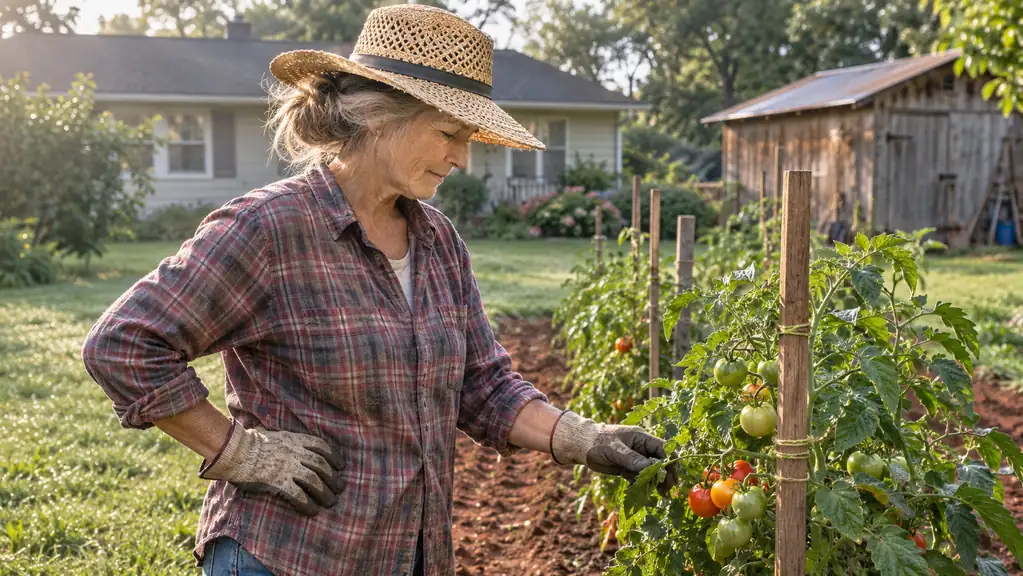
My plot is 20 by 12 feet of red Piedmont clay, gardened every year since 2015. It is better dirt than it was, but it is still clay, and clay does not forgive much. Before I feed anything in the spring I take a handful from about four inches down and squeeze it in my fist. If it holds a ball that will not crumble when I push it with my thumb, the ground is too wet to be in and I wait a day. If it crumbles, I can work.
That is not a soil test. I have never sent a sample to a lab and I am not starting at 58. What the handful tells me is whether the ground is workable and whether it has been holding water, and after eleven seasons in the same plot I can tell you it has been holding water since the year I stopped walking on it in July. That one change did more for the tomatoes than any bag I have ever bought.
It also tells you whether feeding that day is worth doing at all. Food put on ground that is packed and soaked does not go anywhere, because the roots are not working. You have paid for granules that sit on top of a brick. Wait for the crumble. It costs nothing, it takes a minute, and it is the step that makes the other four work.
Step 2: Feed at Planting, Down in the Hole
I set out the six plants in the third week of April, after the last frost, which in this part of the state is mid April and not before. Three Better Boy and three Cherokee Purple. I dig each hole wider than the root ball, because in clay the wide direction is the only direction that helps. A deep narrow hole just gives you a plant sitting in a bucket of water the next time it rains.
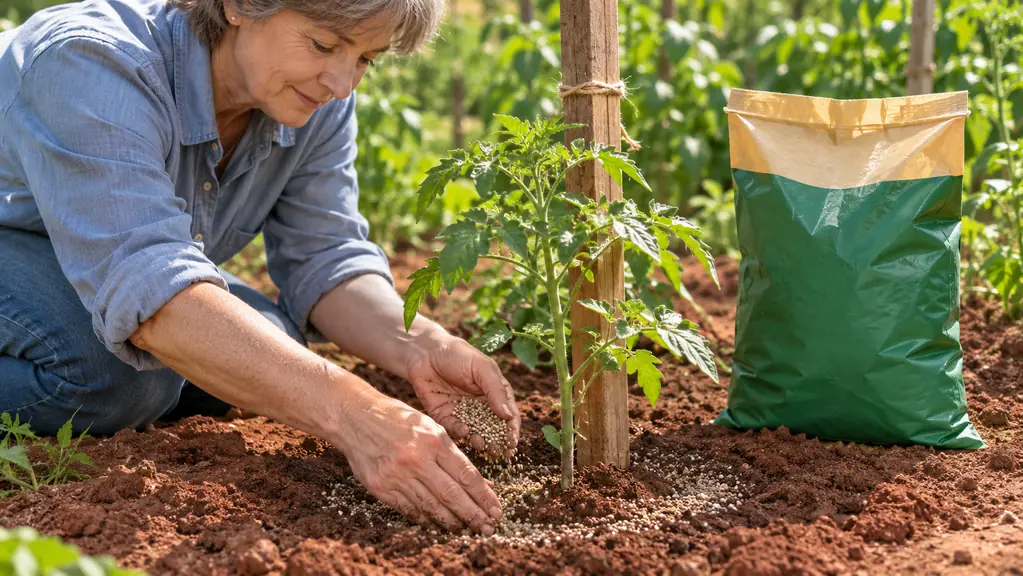
I put a handful of Tomato-tone in the bottom of the hole, stir it into the dirt I took out, set the plant so a couple inches of stem go under the soil line, and backfill. The bag gives a rate for planting holes and I follow it. I am not going to hand you a number of scoops, because my handful is not your handful and the bag already did that math better than either of us.
The calcium is the part I watch. This is 8 percent calcium, and the first summer I used it I had fewer tomatoes with the dark leathery patch on the bottom than I had the summer before. I am not telling you that is why. I changed the fertilizer and I also quit watering in the evening, and I did both in the same April. What I will tell you is what I saw, two summers running, and leave the why alone.
Step 3: Feed Every Two Weeks Whether You Feel Like It or Not
The label says every two weeks through the growing season, and the every two weeks is the part that falls apart. Two weeks in April is not two weeks in July. By July the plants are chest high, the ground is dry by ten in the morning, the squash is trying to take the row, and there is always something that feels more urgent than filling a bucket with granules. I write the date on the kitchen calendar the day I do it. I do not trust my memory past Wednesday.
The way I put it down is a ring around the base, six or eight inches out from the stem, scratched into the top inch of soil with my fingers or the hori hori. Not piled up against the stem. Granules sitting against a wet stem is asking for something you do not want, and it does not help the plant get fed anyway, because the roots out at the drip line are the ones doing the work.
One 4 pound bag does a whole season here, six tomatoes and the row of bell peppers, and the pack of two covered 2025 and 2026 with nothing left over at the end of it. When I am done the Espoma bag goes back in the lidded bucket by the shed door. It smells like a barn for about a day after you open it. That does not bother me. It bothers Roy, who does not garden and has opinions about the shed.
Step 4: Water First, Feed Second, Water Again
Feeding a dry plant is the mistake I made twice before it stuck. Granules on dry ground sit there like sand on a sidewalk. I wet the row the morning I plan to feed, and I mean wet, not damp, and then I go have breakfast and let it soak in. Then the granules go down, and then I water the row again to move them off the surface and into the top inch.
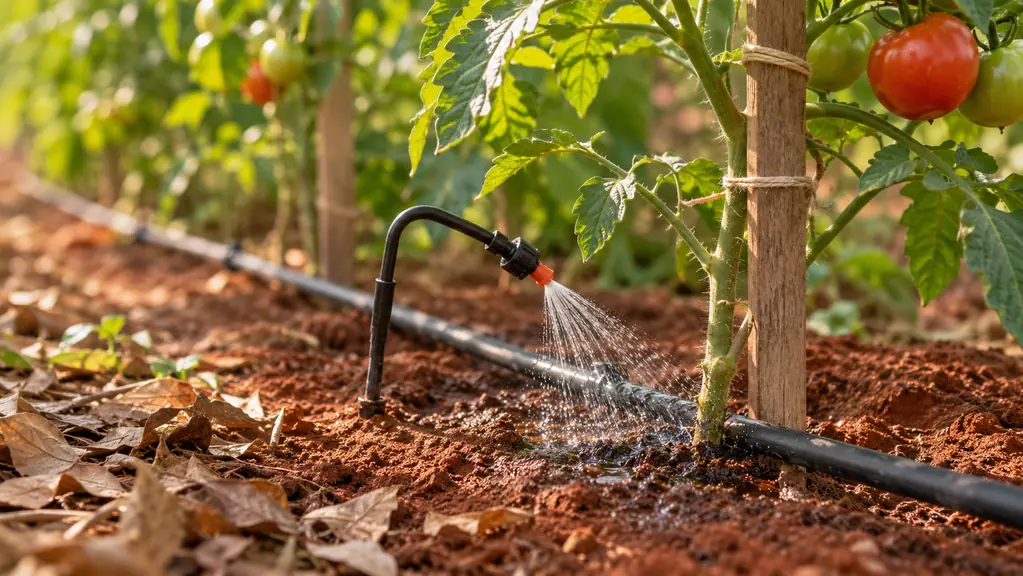
Since May of 2025 most of that watering is a drip line. I run 100 feet of quarter inch tubing off the one spigot on the back wall, sixteen adjustable nozzles on bendable rods, six of them on the raised bed at the south edge of the patio and ten in the plot. I turn the spigot on by hand for about twenty five minutes in the morning and turn it off. There is no timer on it and I never added one. I am out there anyway.
The 2025 planting went in before the drip line did, so the first few weeks were a 50 foot hose dragged around the plot every evening, which is exactly the job I was trying to get out of. I still have the hose. It washes things. What the drip line changed is that feeding stopped being a separate chore, because I could put the granules down and open the spigot and let it water them in while I picked.
Step 5: Feed the Peppers and the Beans, and Not Everything Else
The bell peppers in the plot run on the same two week calendar as the tomatoes. Same clay, same sun, and they set fruit all summer, so they get the same ring. The squash and the pole beans get nothing from me. That ground has been fed since 2015 and those two have never once looked hungry to me.
The raised bed is a different situation and I treat it differently. It went in in April of 2025, 72 by 24 by 30, and it is filled with six 1.5 cubic foot bags of raised bed mix, not my clay. That mix already has food in it. The lettuce, spinach, radishes, green onions, basil and parsley in that bed get nothing from me all season. The only thing in it that gets fed is the bush beans, and they get a light dose, not the full ring I give the tomatoes.
Then you stop. I feed through the end of August and into the first week or so of September, and after that I let the plants finish what is already on them. First frost is around late October here. Feeding a tomato in October is feeding the weeds and the weather.
And nothing about this is fast. Granular food breaks down and the plant takes it up when it takes it up. In 2025 I noticed what I thought was a difference at about the sixth week, which put it in early June, and by July I was fairly sure. If you expect to see something in three days you will be disappointed, and you will probably overfeed to make up for it, which is worse than waiting.
What Else Helps
The fertilizer is maybe a third of it. The rest is water and mud. My clay will turn to brick if you walk on it wet, and I do not care how careful you are, you will compact the row you walk down. I stay out of the plot the day after a real rain, and I do my picking from the grass edge if I have to.
The raised bed dries out faster than the plot in July, which is the one thing about it I would change if I could. It is shallow and it sits above ground and the sun hits all four sides. The drip line runs to it for that reason, and I still push a finger into the mix before I trust it.
And pick earlier than feels right. A Cherokee Purple that comes off the vine at first color and sits on the counter two days beats one I leave for the birds to sample. That has nothing to do with a bag of fertilizer and everything to do with why I still put in six plants at 58 with a back that tires by eleven in the morning.
One 4 pound bag did six tomato plants and a row of bell peppers for an entire season. The pack of two covered 2025 and 2026 and I did not run out in either one.
What I Got Wrong the First Year
I fed the raised bed the same as the plot in 2025. It was new, I was pleased with it, and it seemed like the thing to do. It was not. Nothing died and the lettuce was fine, but that mix already had food in it and I was stacking a plate that was already full. Now the beans get a light dose and everything else in that bed gets water and nothing else.
I also fed once in the afternoon in July, on ground that had been dry since morning, and the granules sat on top of the clay for two days until it rained. I could see them from the patio. Morning, wet ground, water it in. If I cannot do all three that day, I wait until the next one.
The last one is small. I left the open bag in the shed without the lid for a month that first summer, and it took on the smell of the shed, which is a fine smell in a shed and not a fine smell on my hands. It has a lid now, and the lid stays on it.
Two bags, two seasons, six plants at a time
This is the one I keep buying. Espoma Tomato-tone 3-4-6 with 8 percent calcium, 4 pound bags sold as a pack of two. The label schedule, a calendar on the kitchen wall, and a wet morning are the whole system.
Amazon Check Today's Price on Amazon →