

Here is the part of a drip irrigation review that usually gets skipped: the afternoon you spend on your knees with a coil of quarter inch tubing, a bag of connectors, and a temper that is not improving. I do not enjoy the equipment side of gardening. I enjoy the part where I am not dragging a fifty foot hose through red clay at seven in the evening with a sore right knee.
That is the plain reason I bought the MIXC drip irrigation kit in May of 2025. Not because I wanted a system. Because I wanted the hose to stop being my job twice a day in July. Two full seasons later, here is what it actually did, including the part where it dripped on my shoes the first afternoon.
I garden a twenty by twelve foot plot behind the house and one raised bed on the south edge of the patio. Both are watered by this kit now. I paid for it myself, I installed it myself, and I have taken it up and put it back down twice.
The Quick Verdict
It does the one job I bought it for, and it did it on the first afternoon. Just know going in that you are buying tubing, nozzles and connectors, not a watering system with a brain.
Amazon Check Today's Price →The kit that ended my evening hose drag
One hundred feet of quarter inch tubing and sixteen adjustable nozzles on bendable rods. It is not clever. It is the reason my back is not sore at suppertime.
Amazon Check Today's Price on Amazon →What Nobody Tells You Before the Box Arrives
The box does not contain a system in the way most people picture a system. There is no controller, no battery, nothing in it that decides anything on your behalf. What you get is one hundred feet of quarter inch tubing, sixteen adjustable nozzles already mounted on bendable rods, and the connectors that join the whole thing to your spigot. Water pressure does the rest. MIXC rates it to sixty psi and my back wall spigot is ordinary household pressure, so that ceiling has never come up for me.
The second thing nobody mentions is the rule about how many rods one run can carry. MIXC suggests no more than eight rods per fifty feet of tubing. I have sixteen nozzles on one hundred feet, which is exactly that ratio, and I will be honest that I did not read that line until after I had already laid the whole thing out. It worked anyway. But if you are planning to hang twenty nozzles off a short run and expect the far end to spray like the near one, that is where people end up disappointed and blame the kit.
The third thing is what it is made of. Plastic tubing, copper nozzles on bendable rods, push fittings. It is light, it is stiff when the air is cold, and it is not going to last forever in the sun. Treated like equipment it does fine. Left out through a Piedmont winter I would not expect much of it, and I do not think anybody at MIXC would either.
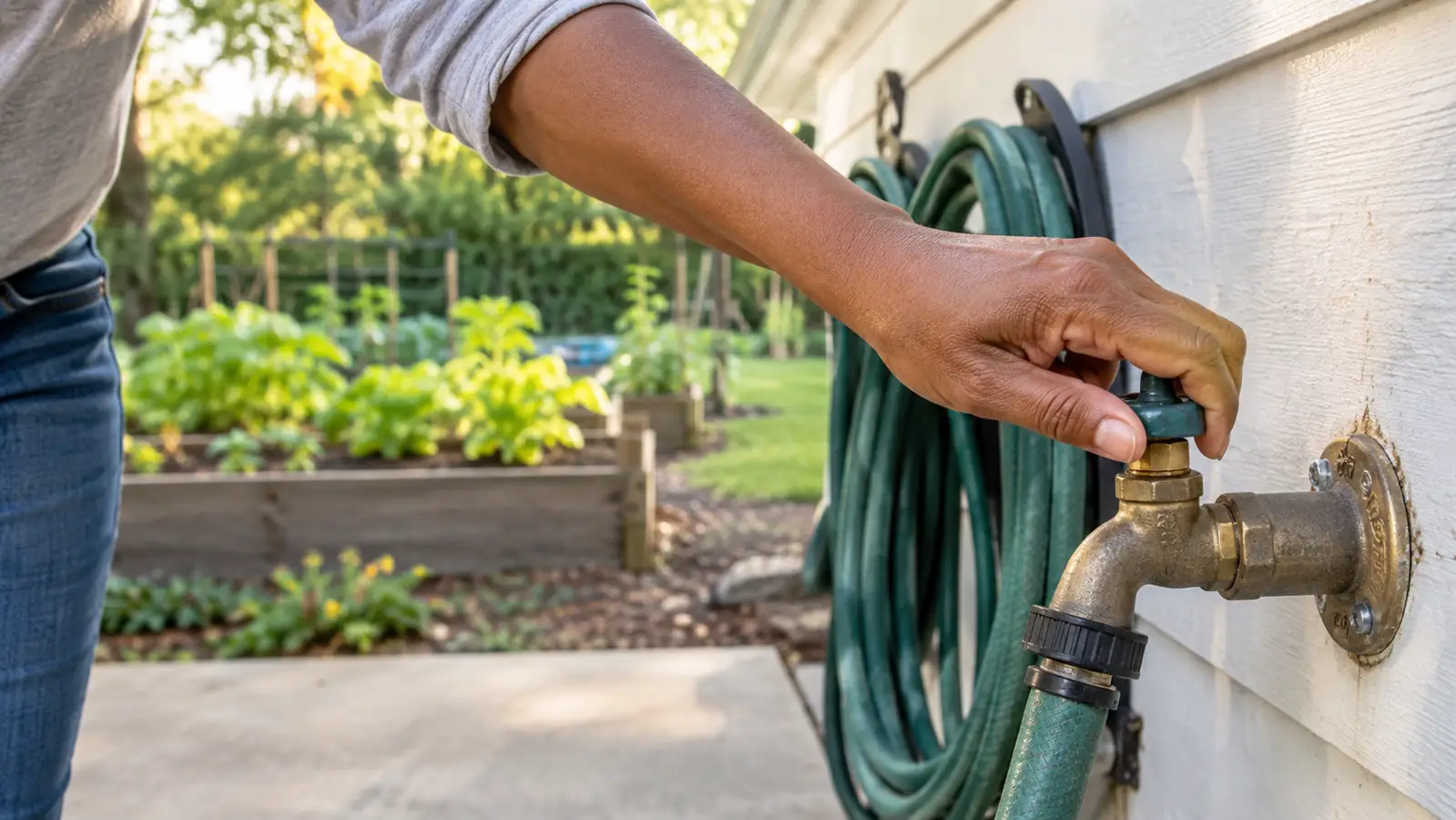
And the fourth thing, which is less about the box and more about you, is that this kit asks for twenty five minutes of your morning. Not twenty five minutes once. Twenty five minutes every morning in summer, with you standing at the spigot, turning a handle. I want that said plainly before anybody buys, because the pictures of drip systems tend to leave the person out of them.

Installing It: Three Hours, and One Connector That Fought Back
I installed it myself on a Wednesday afternoon in May of 2025 and it took about three hours, counting the time I spent standing in the plot with my hands on my hips deciding where things ought to go. Roy did not help. He does not garden, and there is nothing in this job that needs two people except patience.
The split went six nozzles to the raised bed and ten to the in-ground plot. The raised bed got the smaller share because it is smaller, and because that shallow trough of soil dries out faster than the clay does in July, so those six sit close together and nothing gets missed. I used every foot of the hundred and every one of the sixteen. Nothing is left in the shed waiting for a use.
In the plot I ran the tubing down the middle between rows and bent the rods so the spray landed at the base of the plants instead of on the leaves. That one decision matters more than anything in the instructions. Water sitting on tomato leaves in a humid North Carolina July is asking for trouble, and I have gardened here long enough to know it.
The nozzles turn. That is the entire adjustment mechanism and it is enough for me. You twist one and the pattern goes from a narrow stream to something closer to a fan, and the bendable rod lets you point it wherever you want. I set the ones on the raised bed wider and the ones in the plot tighter, and I have not touched most of them since. My hands are not what they were, and I did not need them to be.
Then there was the connector. One of them dripped the first time I turned the water on, a slow bead that ran down and left a dark spot on the patio. I pushed the tubing further into the fitting until I felt it seat and turned the water back on. That was the end of it. I have not had a leak since, across two seasons and two full tear-downs. I am not going to pretend that was a pleasant twenty minutes, but the fix was obvious once I stopped being aggravated.
What It Replaced, and What That Was Costing Me
Before this I watered with a fifty foot garden hose, and I had been doing it that way since 2015. Every evening in summer I dragged it out, walked the plot, stood there with my thumb over the end of it, and dragged it back. Then I did the raised bed. My right knee is the worse of the two and it let me know about it most nights.
I still own that hose. It hangs on the side of the house and I use it to wash the patio and rinse out buckets. What I do not do anymore is water with it. That is the whole change, and it is the only change I was after. I did not buy a system because I wanted a system. I bought it because I had an evening chore that took twenty minutes and cost me a night of sleep afterward.
I never kept numbers on any of it, so I cannot tell you what this saved in water or in hours. Nobody in this house weighs a harvest. What I can tell you is that the evenings came back to me, and that in July of both years the plants in the plot were getting water at the base every morning whether I felt like it or not. That is as far as I will go.
What I Liked
- Sixteen adjustable nozzles on bendable rods, so you aim water instead of hoping
- One hundred feet reached both the plot and the raised bed with nothing left over
- No timer, no battery, no app, nothing extra to fail or replace
- Coils up and hangs on a peg in the shed for winter
- Setup was one afternoon and I did it alone at fifty eight
Where It Falls Short
- One connector needed reseating on day one before it stopped dripping
- Plastic tubing will not take being left out through winter
- Sixteen nozzles is the whole kit, adding more means buying more pieces
- The instructions are thin, you work most of it out by looking at it
I did not want a system. I wanted to stop dragging a hose through clay at seven in the evening with a knee that had already done its day. That is the entire review.
Two Seasons In: What Still Holds Up
The second April, I laid it out again and it went down faster because I already knew the shape of it. Same sixteen nozzles, same six and ten split, same run down the middle of the plot. Nothing had cracked in the shed over the winter. The rods still bend and still hold where you bend them, which is the part I expected to go soft first.
What I notice now is not the water. It is that watering stopped being a thing I think about. The spigot goes on by hand every morning in summer for about twenty five minutes, then it goes off, and that is the whole of it. I have never added a timer and I do not intend to. That sounds like a small thing until you set it next to what I was doing before.
One more note on the raised bed. That shallow trough was drying out by mid morning in July, which is exactly why I ran six nozzles to it instead of three. Now it stays damp under the lettuce and the spinach through the hot part of the day, which is all I ever wanted from it.
The Leak on Day One, and Why There Has Not Been Another
I am giving the leak its own heading because any honest review of a thing with fittings in it should. Day one, one connector, one drip. I pushed the tubing in harder and it stopped. Since then, across sixteen nozzles, a dozen or so fittings and two drain and re-lay cycles a year, I have not had a second one.
The trick, which I only know because I got it wrong once, is that the tubing has to go in further than it feels like it should. It is stiff quarter inch line, and there is more travel in those fittings than your hand expects. Stop short and you get the bead of water. Push until it seats and you get nothing. Every April when I reconnect, I check each one by running my thumb along it with the water on, and then I leave it alone.
There is a version of this review where the writer tells you the fittings are junk and the kit is a waste of an afternoon. I cannot write that honestly. There is also a version where nothing ever dripped and the whole install was a delight, and I cannot write that either. One fitting wanted a firmer push. That is the entire complaint column for the plumbing.
What This Kit Will Not Do
It will not water for you. There is no timer, no battery, no sensor, nothing that reads the weather or knows you left. If you go away for a week in July this kit does nothing at all, and the plot will tell you about it when you get home. That is not a defect exactly. It is the thing to know before you buy, because plenty of drip kits come with a controller and this one is not one of them.
It will not cover more ground than it covers. One hundred feet and sixteen nozzles is what is in the box. Once you have used all sixteen, you are done unless you buy more pieces. Mine went exactly the distance of a twenty by twelve plot plus one raised bed, and not a foot more. If your garden is bigger than that, plan on two kits.
And it will not survive being ignored. Every November I drain it and coil it onto a peg in the shed, and every April I lay it back out. I have never owned a soaker hose, so I will not compare the two from experience, but Doreen two doors down has run one for years and leaves it out, and hers is the color of old milk by August. Mine still looks like tubing, and that is because of the shed, not because of anything MIXC did.
What I Would Do Differently
Two things. I would read the line about eight rods per fifty feet before I laid anything out, not after. It happened not to matter for me because I landed on that ratio by accident, but if I had wanted sixteen nozzles on a shorter run I would have had a thinner spray at the far end and no idea why.
And I would aim the nozzles with the water running instead of guessing and going back. I bent every rod to where I thought it should point, turned the spigot on, and spent another twenty minutes moving about half of them. Water on the leaves is the thing I am trying to avoid and I put water on the leaves on the first pass. Set them with the water on, one at a time, and save yourself the second lap.
Who This Is For
This is for a gardener with a plot or a couple of raised beds and a spigot on the back wall. Somebody who is tired of carrying a hose and does not want to spend an evening learning an app to do a job a handle already does. It suits a body that does not bend the way it used to, because once it is laid out the only work left is turning the spigot.
It also suits somebody who is home in the mornings. That is the trade. You get to stop dragging a hose and you agree to be there to turn the water on. I retired in 2023, so that trade costs me nothing. If your mornings are spent somewhere else, be honest with yourself about it before you buy.
Who Should Skip It
Skip it if you travel in summer and need something that waters itself while you are gone. This is not that, and no amount of wanting it to be will make it so.
Skip it if your garden runs bigger than about a hundred feet of line, because you will be ordering a second kit before the season is out and it will annoy you. Skip it if you plan to leave plastic tubing in the ground through a Piedmont winter. And skip it if you want to open a box and be done with the thinking. There is thinking here. It is not hard thinking, but it is yours, not the kit's.
For everybody else, the honest summary is this. MIXC sold me tubing, nozzles and connectors for one afternoon of my May, and in return I have not dragged a hose through red clay since. Two seasons, one stubborn connector, sixteen nozzles still pointing where I put them. I would make that trade again.
Two seasons, one drip, no hose
Sixteen adjustable nozzles and one hundred feet of tubing, and about three hours of a Wednesday in May. That was the deal, and I would take it a second time.
Amazon Check Today's Price on Amazon →